Get Full Government Meeting Transcripts, Videos, & Alerts Forever!
Get email alerts on the Criminal Justice topic
No spam. Unsubscribe anytime.
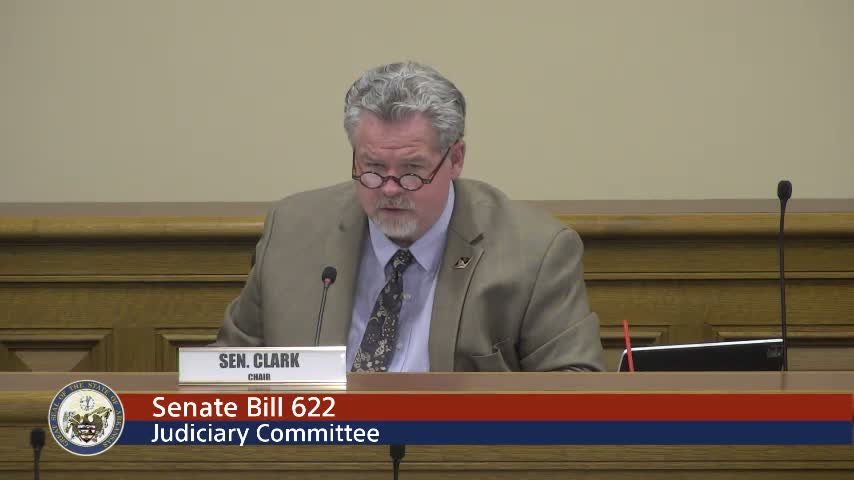
Senate Judiciary Committee advances bill delaying release for violent offenders who target protected groups
Summary
The Senate Judiciary Committee voted to advance SB 622, which would require certain violent felony offenders who targeted victims based on membership in a "recognizable and identifiable group" to serve a minimum of 80% of their sentence and would create a registry; the committee debated whether the measure functions as a hate-crimes law and heard competing testimony.
The Senate Judiciary Committee voted to advance SB 622, a measure that would delay release for certain violent felony offenders who targeted victims because of membership in a "recognizable and identifiable group," and would require those convicted under the aggravating circumstance to serve at least 80% of the original applicable sentence.
The bill, presented by Senator Hickey, would apply only after a defendant is convicted of one of the listed violent crimes. "This bill provides for delayed release for certain violent felony offenders," Hickey said, and the measure creates "a registry through the Arkansas Crime Information Center of persons who are sentenced under the offense of delayed release under this bill." He told the committee the bill "does not create any new crime" or increase statutory maximums but changes eligibility for release so a convict must serve a minimum of 80%.
Supporters argued the language protects a wide range of victims. Randy Zook of the Arkansas State Chamber of Commerce told the panel businesses are watching the state’s approach to these laws and said the chief concern of his members is talent recruitment: "People turn down jobs because of what they learn about the legal climate in Arkansas," he said, urging lawmakers to consider the bill's effect on attracting investment and workers.
Opponents warned of vagueness and enforcement risks. Jerry Cox, director of Family Council, said the text tells "what it does not mean," but "nowhere in the bill does it tell what it does mean," asking, "what does it mean to purposely select?" Cox also raised free-speech and investigatory concerns, questioning how far prosecutors might go to establish motive based on past statements or associations.
Committee members pressed sponsors on several procedural and legal points. Senator Garner and others clarified that the aggravating circumstance would be evaluated only after conviction and that juries or judges would hear additional evidence in a secondary phase. Bob McMahon, prosecutor coordinator, told the committee that "you have to get a conviction first" before the aggravating-phase would be analyzed and that prosecutors would need to prove the aggravating circumstances beyond a reasonable doubt.
Senator Hendren proposed an amendment to append an explicit list of traditionally targeted groups to the bill’s definition; he argued listing categories would give victims clearer assurance the law covers them. That amendment failed for lack of a second. An earlier sponsor amendment clarifying the 80% minimum was adopted.
On a final voice vote, the committee approved a motion that the bill "do pass as amended." The chair declared the motion carried and adjourned the committee; the panel will reconvene Wednesday at 9:30 a.m.