Get Full Government Meeting Transcripts, Videos, & Alerts Forever!
Get email alerts on the Criminal Penalties topic
No spam. Unsubscribe anytime.
Arkansas panel raises hit-and-run penalty after victims testify; lawyers warn of constitutional risk
Summary
The Senate Judiciary Committee advanced House Bill 1505 to raise penalties for hit-and-run incidents that cause serious injury or death, following emotional testimony from victims—s families and a contested legal debate over whether the measure creates a strict-liability felony. The bill passed the committee as offered.
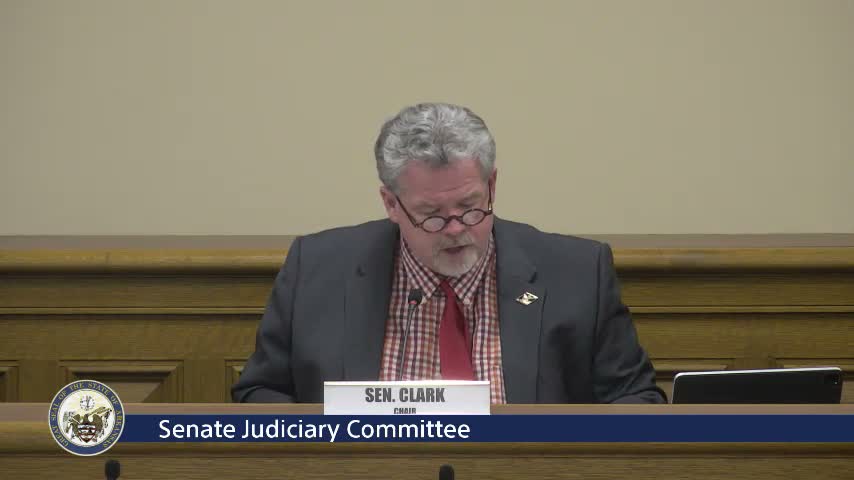
The Senate Judiciary Committee on Wednesday voted to pass House Bill 1505, which raises the penalty for fleeing the scene of an accident that results in serious physical injury or death from a class D felony to a class B felony.
Representative Fite, who sponsored the bill, said it was brought at the request of the Hit and Run Project in Fayetteville and intended to reduce the incentive to flee rather than stop and render aid. "We are saying if there is a serious physical injury to or death to another person, he or she upon conviction is guilty of a class B felony," Fite said.
Two witnesses with personal losses urged the change. Stacy Bankston, who identified herself as a licensed clinical social worker and a mother who lost her child in a hit-and-run, told the committee, "According to the U.S. Department of Transportation, hit and runs claim the lives of nearly 15 people per day." She described her son—s death and said prosecutors had to pursue only the lower offense in similar past cases because evidence to prove greater charges was often unavailable.
Kimberly Mundell, who said her husband died after a hit-and-run, told senators the current punishment "is only a D felony at this point," and said strengthening penalties would give "families more recourse for action."
The bill prompted pushback from criminal-defense advocates. Jeff Rosenzweig of the Arkansas Association of Criminal Defense Lawyers cautioned the committee that, as currently written and as interpreted by Arkansas precedent, the offense can be treated as strict liability. "If you enact this bill as is, you're probably enacting yourself into a constitutional problem," Rosenzweig said, arguing a significantly higher maximum penalty for a strict-liability crime risks federal constitutional challenges.
Several senators urged compromise. "So we could add that mens rea, which I think would make it much better," Senator Garner said during floor questioning, urging insertion of a knowingly or recklessly standard so courts would have a culpable mental-state requirement for the more severe penalty.
Representative Fite and other supporters said the bill aims to remove the perceived advantage of fleeing to avoid proof elements that allow prosecutors to bring more serious charges. Fite told the committee she had been advised the transportation code and relevant court decisions meant the current statute operates without an intent element in many cases.
After extended questioning and public testimony, the committee approved the bill by voice vote. The record shows no formal roll-call tally in committee minutes.
The committee action now sends the measure to further consideration on the Senate floor under the legislative calendar.