Get Full Government Meeting Transcripts, Videos, & Alerts Forever!
Get email alerts on the Civil Asset Forfeiture topic
No spam. Unsubscribe anytime.
Split views as Senate committee hears sweeping civil forfeiture overhaul; sponsor agrees to revise bill
Summary
Senator Clark’s SB197, which would move many forfeitures into the criminal process, raise minimum seizure thresholds and require conviction before forfeiture, drew strong opposition from law enforcement, prosecutors and sheriffs and support from defense and public‑defender advocates. After hours of testimony, the sponsor agreed to pull the bill to negotiate changes.
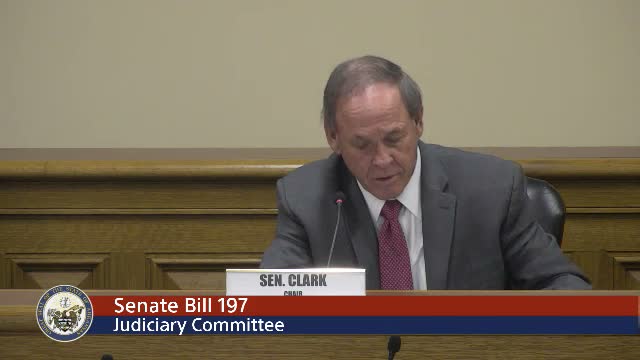
Senator Clark told the Senate Judiciary Committee he filed SB197 to curb what he called unjust seizures of small-value property and to align forfeiture practice with Fourth Amendment protections. "SB 197 ends civil forfeiture," Clark said, summarizing a central change: moving many forfeiture actions into the criminal court and requiring conviction before the state may forfeit property in most cases.
The sponsor and supporters described a recurring problem of low-dollar seizures that cost owners more to litigate than the property’s value. Clark cited committee hearing figures showing that roughly 62 percent of seizures since 2010 were under $1,000 and nearly 90 percent were below $5,000. The bill would set minimums (no seizure for cash under $200, vehicles under $2,000) and flip certain procedural burdens so government must prove wrongdoing after conviction, while preserving exceptions for abandoned property, deported or deceased defendants, and certain federal collaborations.
Opponents included the Arkansas State Drug Director, law-enforcement leadership and the State Police, who warned the changes would hamper investigations of drug-trafficking organizations that rely on civil forfeiture to seize bulk currency and instruments used in criminal enterprises. Kirk Lane, the state drug director, told senators the current statute supports a repository and audit system that provides transparency and oversight; he said SB197 "guts" key safeguards. Bill Bryant, director of the Arkansas State Police, warned that civil forfeiture’s lower civil standard (preponderance of the evidence) is a tool investigators use to build larger cases and to disrupt cartels' finances.
Public-defense and civil‑liberties witnesses voiced the opposite concern: Jeff Rosenzweig of the Arkansas Association of Criminal Defense Lawyers said the core question is whether the state should be able to keep a person's money when that person is not convicted. Greg Parrish, director of the Arkansas Public Defender Commission, supported the policy objective but cautioned that moving forfeiture fully into criminal cases raises conflicts for public defenders and could require separate counsel for asset issues because those actions concern property rather than liberty.
Affected third parties also testified. Patricia Tackett described losing a camper, a Bronco and a boat after a law‑enforcement action involving her son and recounted confusing notice and paperwork that she said left her unable to recover personal items. Her account underscored committee concerns about notice, process, and the experience of third parties who are not charged or convicted.
Several county sheriffs and chiefs urged stakeholder discussion and incremental fixes: some argued for minimum thresholds already in local policy and offered to negotiate targeted statutory changes. Forensic and crime‑lab officials warned SB197 could reduce proceeds available to laboratories; Kermit Channel reported lab funding from forfeiture proceeds of roughly $500,000 and urged the committee to consider lab capacity when altering proceeds distribution.
After more than five hours of testimony and multiple procedural questions about remaining witnesses and time limits, Senator Clark told the committee he would pull SB197 to work with stakeholders on changes. "I'll be glad to sit down with you and others on possible ways to fix this," Clark said. The committee agreed; the bill was pulled for further consideration and the meeting adjourned.