Get Full Government Meeting Transcripts, Videos, & Alerts Forever!
Get email alerts on the Eminent Domain topic
No spam. Unsubscribe anytime.
Senate committee advances bills to codify Arkansas eminent‑domain limits
Summary
The Senate Judiciary Committee advanced two companion bills (state and municipal versions) that would codify Arkansas case law limiting use of eminent domain — including a prohibition on takings for a "purely economic purpose" — after testimony from municipal officials raising procedural concerns.
Senator Ballinger told the Senate Judiciary Committee that Senate Bill 334 and a companion measure for cities and counties would "codify existing case law" and make explicit that a "purely economic purpose is not a sufficient purpose to take property." The sponsor said the bills would set a process for addressing blighted or abandoned property consistent with current practices.
The bills' sponsor argued the changes simply put longstanding judicial precedent into statute so attorneys and local governments would not have to rely only on case law. "So this essentially is codifying what we have," he said.
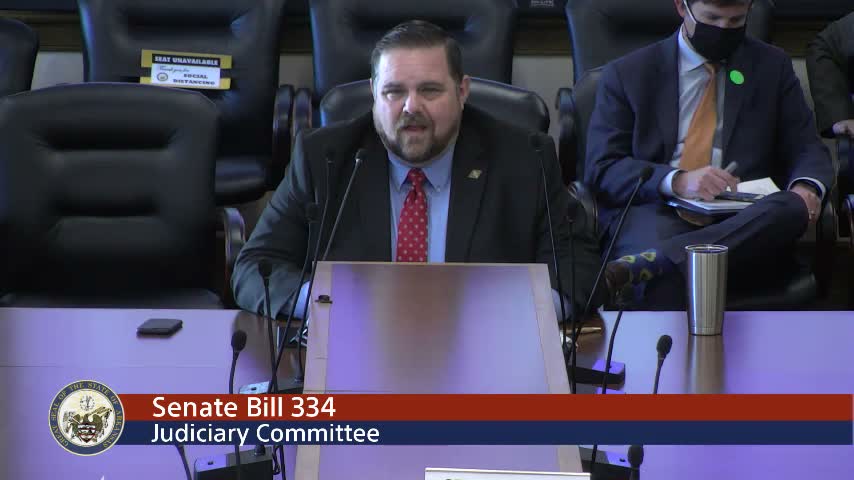
Blake Gary, legal counsel for the Arkansas Municipal League, urged caution, telling the committee the municipal version is unnecessary and could pose procedural problems. Gary said Article II, Section 22 of the Arkansas Constitution and more than a century of state Supreme Court precedent already bar takings for private, economic development. He raised particular concern about a provision (c)(4) that, in his view, "would require the local government to prove a negative condition" — effectively shifting the burden of proof to municipalities to show there was no feasible alternative route or acquisition.
James Walden, representing the City of Conway and the Arkansas chapter of the American Planning Association, described practical planning constraints that can make alternatives infeasible, citing corridor planning, right‑of‑way negotiations and the engineering limits of gravity sewer mains. Walden said municipalities often purchase rights‑of‑way in advance to relieve property owners of uncertainty and that the bill's timing and funding tests could complicate long‑range planning.
Senator Ballinger closed by citing City of Little Rock v. Raines and other precedent to argue the bills would align statute with judicial standards and with best practices. The committee adopted amendments and advanced the state and municipal versions on voice votes.
Next steps: The measures were advanced by the Judiciary Committee and will proceed according to the Senate calendar.