Get Full Government Meeting Transcripts, Videos, & Alerts Forever!
Get email alerts on the Online Harassment And Doxing topic
No spam. Unsubscribe anytime.
Panel approves rewritten doxing bill after testimony raising vagueness and First Amendment concerns
Summary
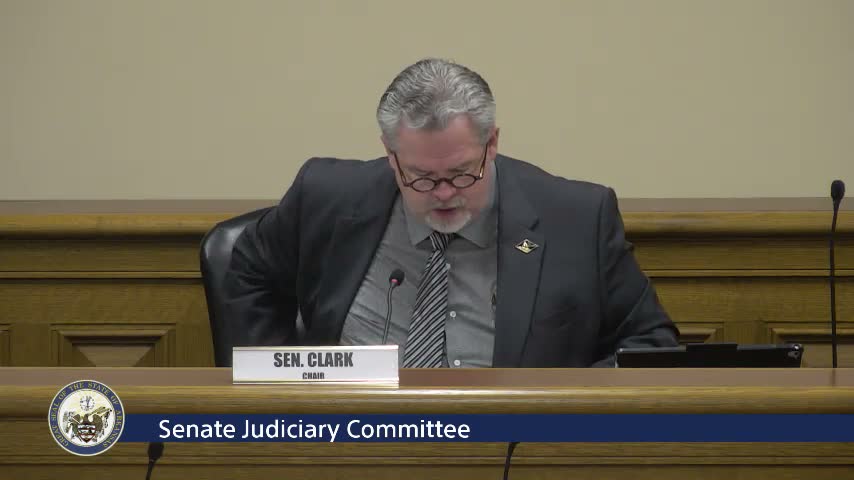
Senate Bill 170, a rewritten "doxing" bill aimed at protecting minors, passed the Judiciary Committee 5-1 after testimony from criminal-defense lawyers warning the measure contains undefined terms ("malicious," "due to") and may reach constitutionally protected speech. Sponsor said he relied on existing cyberbullying language.
Senator Garner presented an extensively amended version of SB170 that he described as a distinct offense from cyberbullying and focused on doxing of minors that causes a reasonable fear of physical injury. Garner said he borrowed the communication definition from the state's cyberbullying statute and created a tiered punishment scheme tied to harm (felony classes for severe outcomes, misdemeanors for less severe harms).
Jeff Rosenzweig of the Arkansas Association of Criminal Defense Lawyers testified against the bill, pointing to multiple drafting concerns: the statute as written permits criminalization of information that is already public (line 27), it uses the undefined term "malicious," and it substitutes phrases such as "due to" where the criminal code typically uses "cause," potentially changing causation standards. Rosenzweig urged defining terms and tightening language.
Christopher Keller, an attorney, raised First Amendment concerns and said the bill's breadth could criminalize a wide range of speech (transmitting communications intended to "frighten, coerce, intimidate, threaten, abuse, or harass"). Sponsor Garner responded that the language mirrors existing cyberbullying law and that the bill narrows coverage to minors with a reasonable fear; he moved the bill and it passed by roll call 5 to 1, with Senator Flowers opposed.
Committee debate focused on mens rea (mental-state) language and whether "malicious" is sufficiently defined for criminal application. Opponents warned of vagueness challenges in criminal prosecutions; sponsor said he revised the bill to respond to committee input and relied on precedent from the cyberbullying statute.