Get Full Government Meeting Transcripts, Videos, & Alerts Forever!
Get email alerts on the Covid Courts topic
No spam. Unsubscribe anytime.
AOC, public defenders and bar warn pandemic backlog, broadband gaps hinder Arkansas courts
Summary
Arkansas court officials told the Senate Judiciary Committee that courts adapted with Zoom and e‑filing, distributed PPE, and held some jury trials between July and November, but uneven broadband, differing local closures and suspended criminal jury trials pose a backlog and equity problems for rural communities and indigent defendants.
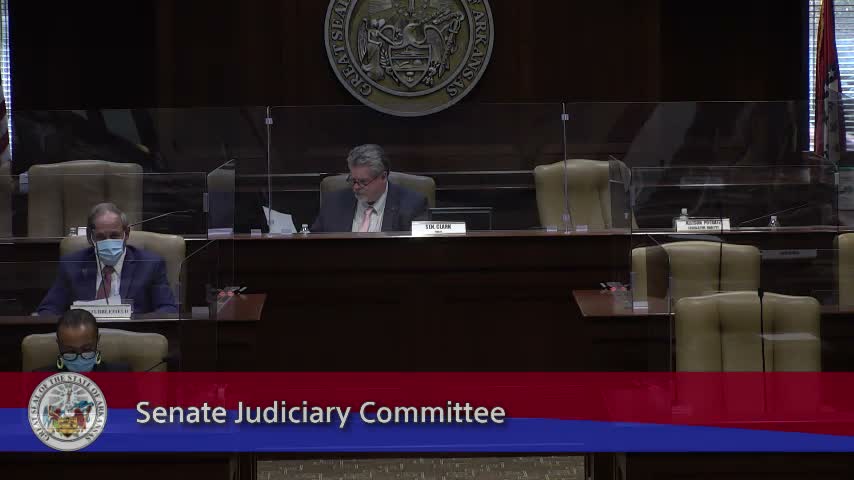
Arkansas court administrators, the state public defender commission, and the bar association told the Senate Judiciary Committee on Dec. 18 that the judiciary has adapted to the pandemic but faces a growing backlog, uneven access to virtual services in rural areas, and serious implications for criminal defendants.
Kristen Clark of the Administrative Office of the Courts said the Supreme Court issued per curiam orders keeping courts open while balancing public health. The AOC expanded Zoom use, accelerated e‑filing (about 64% of circuit courts), and distributed PPE and screening supplies — including more than 700,000 disposable masks, 272 medical thermometers, about 15,000 bottles of hand sanitizer and more than a million pairs of gloves — to help courts operate safely.
"Most courts are thinking outside the box," Clark said, but she warned that criminal jury trials were suspended until January and that local decisions by county officials to close facilities have produced uneven service across circuits. Between July and November the court system held about 50 jury trials in jurisdictions that resumed in‑person operations, Clark said, but civil jury trials remain especially affected.
Paul Keith, president of the Arkansas Bar Association, and trial‑lawyer representatives said broadband and venue constraints limit virtual options in rural areas and urged creative local solutions such as using church or school auditoriums or designating courthouse staff and jurors as essential personnel for vaccine prioritization. "The people that have the most success with Zoom hearings are in metropolitan areas," Keith said, noting that parts of South Arkansas lack robust broadband.
Public defenders described the consequences for criminal defendants. Greg Parrish, executive director of the Arkansas Public Defender Commission, said defenders cannot always visit clients in penitentiaries or county jails and expressed concern about speedy‑trial rights, confrontation, and the difficulty of building attorney‑client trust remotely. Parrish urged lawyers to object when judges enter blanket continuances, to preserve clients’ speedy‑trial claims, and asked the state to consider essential‑personnel designations so defenders and courtroom staff can be prioritized for protective measures.
Trial lawyers and local judges proposed alternatives — hybrid trials, alternate venues and using standardized sentencing for nonviolent cases temporarily to reduce pressure — but the witnesses acknowledged funding and logistical barriers in smaller counties. Several members expressed particular concern for equity: counties with poor broadband, fewer alternate venues, or limited budgets face greater obstacles in resuming jury operations.
The committee received several follow‑up requests, including a financial review of courthouse fee flows and the administration of justice fund, and more granular data on which circuits have resumed which types of trials. No formal changes were made at the hearing; members said they will consider committee recommendations and coordinate with AOC and stakeholders on steps to resume court operations more uniformly.
Next steps: AOC task forces will continue to refine guidance for resuming jury operations, and the legislature requested analysis of the administrative fund impacts and possible options to prioritize access to trials in under‑served counties.