Get Full Government Meeting Transcripts, Videos, & Alerts Forever!
Get email alerts on the Police Training And Accountability topic
No spam. Unsubscribe anytime.
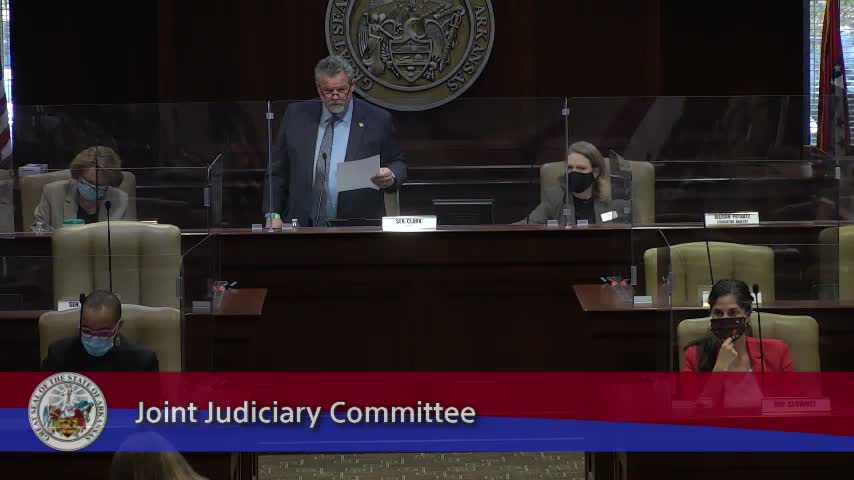
Senate Judiciary Committee hears law‑enforcement leaders on training, decertification and recruitment
Summary
State training officials and law‑enforcement leaders told the Senate Judiciary Committee that Arkansas requires ethics and bias training across police academies, that the state can decertify officers for ethics violations, and that recruitment and funding shortfalls are stressing departments statewide.
Senator Clark convened a Judiciary Committee hearing where Jamie Cook, secretary of the Arkansas Department of Public Safety and director of the Commission on Law Enforcement Standards and Training (CLEST), and law‑enforcement leaders outlined how the state trains officers and handles decertification.
Cook told the committee CLEST oversees roughly 600 departments and 11,000 officers and supervises basic police academies, and said Arkansas requires a two‑hour racial‑profiling component in continuing education each year and integrates ethical instruction into every block of academy training. "Every block of instruction, regardless of what the subject is, has to include an ethical component," Cook said.
Why it matters: Committee members pressed officials on whether training addresses implicit bias, crisis intervention and de‑escalation. Deputy director Fred Weatherspoon described scenario‑based exercises designed to provoke realistic reactions so instructors can correct officers before they enter the field. Cook said Arkansas is unique among many states in having statutory authority to decertify officers for code‑of‑ethics violations and described the commission process: a probable‑cause determination by the 10‑member commission followed by Administrative Procedures Act hearings and the right to appeal to circuit court.
Law‑enforcement leaders urged standardization and sustained funding. Gary Sipes, executive director of the Arkansas Association of Chiefs of Police, and several chiefs and sheriffs advocated state and agency accreditation and model policies to reduce variation across departments. Chief Rick Elliott of Jonesboro said accreditation systems and local community engagement programs—citizens police academies, ride‑alongs and regular outreach—help reduce friction between officers and communities. Sipes said accreditation helps require chiefs to review racial and traffic‑stop statistics and that smaller agencies need state support to fund body cameras and training.
On backlog and accountability: Cook told the panel CLEST had 40 pending cases (26 added in 2020) and that the commission will increase meeting frequency to reduce hearing delays. She said, "In Arkansas, again, we're very unique in that when you are decertified in Arkansas, you're decertified forever." Committee members asked how timeliness and transparency would be ensured in internal and commission hearings.
Next steps: Committee members and witnesses repeatedly pointed to three priorities—expanded funding for training and data systems, broader accreditation and model policies for local agencies, and clearer, accessible complaint channels to ensure investigations proceed and are communicated to complainants. The committee recessed after hearing multiple panels and scheduled follow‑up outreach.
Ending: No formal legislation was adopted at the hearing; members said they would continue discussions and consider policy options and funding requests in coming weeks.