Get Full Government Meeting Transcripts, Videos, & Alerts Forever!
Get email alerts on the Committee Roundup topic
No spam. Unsubscribe anytime.
Senate Judiciary Committee advances package of criminal‑justice and family‑law bills, amid debate over juvenile oversight
Summary
The Senate Judiciary Committee approved a slate of bills by voice vote, including measures on recovery of medical costs, foster‑care definitions tied to Family First, penalties for delivering drugs in prisons, and changes to juvenile‑code definitions. A proposed increase in legislative review powers over dependency/neglect cases prompted sustained concern from a juvenile judge.
The Senate Judiciary Committee on Monday advanced a string of criminal‑justice and family‑law measures, approving amendments and moving most bills out of committee by voice vote.
Committee members unanimously concurred in a House amendment to Senate Bill 109, which narrows the bill so it applies only to the Department of Corrections and Community Corrections rather than youth services or counties. Senator Irvin, who presented the concurrence, said the change came through agreement with House members.
Senator Bledsoe’s SB503, which creates an offense for promoting a suicide attempt and enhances penalties related to physician‑assisted suicide, also passed after the sponsor described two parts of the bill — an enhancement and a new section defining promotion of an attempt — and offered minor technical corrections.
On SB545, Senator Irvin said the bill simply changes recovery of damages so plaintiffs recover the amount actually paid for medical services (the negotiated, paid amount) rather than the service provider’s higher billed rate. The senator and other members discussed potential legal precedents; one member cited Johnson v. Rockwell as a possible constraint.
The committee approved an amendment to SB543 removing an emergency clause and heard legal testimony explaining that the change lets juries be instructed to consider the percentage of fault of an immune nonparty (the jury may apportion fault but recovery is limited to the liable defendant’s share). Justin Allen, an attorney speaking for the sponsor, framed the change as allowing juries to consider the fault of an immune actor for apportionment purposes.
The panel also moved a package of House bills. HB1469, described by Craig Cloud of the Department of Human Services, aligns Arkansas’s foster‑home definition with the federal Family First Prevention Services Act so the state can continue to qualify for Title IV‑E funding. Cloud said the change is largely technical and reflects stakeholder consensus.
Representative Gasway presented a bill to add controlled substances to the definition of prohibited articles and to criminalize delivery of drugs from inmate to inmate; ADC representatives told the committee they had identified gaps that left some intra‑facility delivery conduct uncharged and said the proposal aims to deter trafficking that has led to inmate deaths.
Other bills passed on voice votes include HB1280 (allowing judges discretion to impose up to one year of probation for a third public‑intoxication offense within five years, without increasing maximum jail exposure beyond 30 days), HB1610 (raising the grading of intoxication‑related second‑degree battery that causes serious physical injury), and HB1679 (revising a statutory bench‑warrant requirement from "shall" to "may" in particular circumstances to avoid unnecessary rearrests).
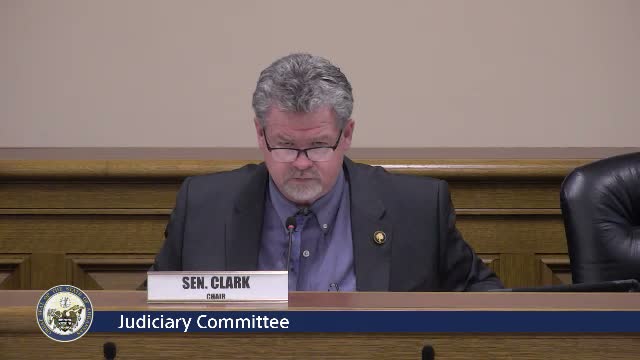
The most contested discussion surrounded an amended oversight bill (S B 537) that broadened the Child Maltreatment Investigations Oversight Committee’s membership and authority. Judge Zimmerman, a juvenile judge from Washington County, testified in opposition, warning that the bill’s wording permitting review and evaluation of completed dependency/neglect cases risked an improper legislative intrusion into judicial functions. Senator Clark and supporters said the committee’s intent is policy oversight and study, not an appellate function, and proponents framed the change as necessary to identify systemic problems and improve outcomes for children and families.
All actions in the hearing were recorded as voice votes in the transcript; specific roll‑call tallies were not entered in the committee record provided.
What happens next: bills that left committee will move to the Senate floor for scheduling and further consideration; the oversight and suicide‑related measures may require coordination and potential technical amendments before final passage.