Get Full Government Meeting Transcripts, Videos, & Alerts Forever!
Get email alerts on the Sentencing Reform topic
No spam. Unsubscribe anytime.
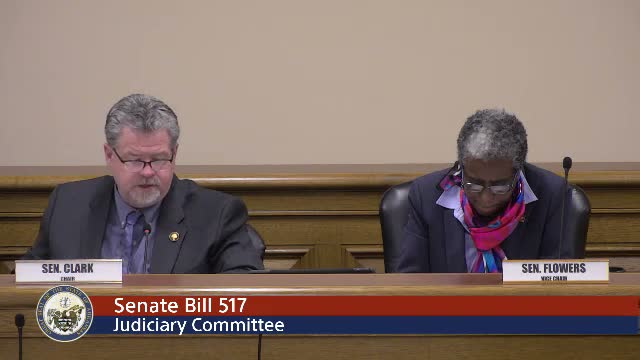
Committee debates SB517 on retroactive relief for life sentences in nonviolent drug cases, pulls bill for revision
Summary
Senate Bill 517, which would remove life sentences for certain nonviolent drug convictions and apply relief retroactively for a narrowly defined list, drew hours of testimony from prosecutors, judges, advocates and family members; prosecutors warned retroactivity is complex and the sponsor agreed to pull the bill to craft narrower language and gather additional information.
Senate Bill 517 prompted an extended Judiciary Committee hearing and extensive public testimony before the sponsor said he would pull the measure for more work.
Senator Bond presented SB517 as a limited measure to eliminate life sentences for nonviolent drug offenses going forward and to provide retroactive relief for a small group of people identified in committee materials (sponsor referenced approximately 17 individuals). He said the bill would preserve accountability—making the maximum punishment for these offenses up to 40 years—but would remove life as a possible sentence for the specified nonviolent drug convictions and include a retroactivity provision for a narrowly drawn cohort.
Prosecutors and the prosecutors' association opposed retroactivity and urged caution. Bob McMahon and Kyle Hunter told the committee that many cases on the sponsor’s list reflected lengthy criminal histories or habitual offender labels and argued that jury verdicts, contemporaneous sentencing context and other charges considered at sentencing make retroactive relief complex. They recommended case‑by‑case review and said compiling the necessary records could be time‑consuming.
Advocates and family members testified in favor of retroactivity, describing individual stories — long incarcerations, advanced age, serious medical conditions and executive‑clemency denials. Several witnesses said parole boards had at times recommended clemency but governors or the executive branch had not acted. Former judge Marion Humphrey testified in support and identified cases he had presided over where heavy sentences now appear excessive given later legal developments and alleged ineffective assistance of counsel at trial.
Committee members raised detailed questions about how many of the listed individuals had additional convictions that would prevent immediate release if sentences for nonviolent drug offenses were changed; several senators urged a process that preserved public safety while allowing relief for arguably excessive sentences. Senator Bond told the committee he would pull the bill to work with prosecutors and stakeholders to craft narrower language — for example, giving parole boards additional flexibility or specifying eligibility criteria — and to verify criminal‑history details for listed individuals.
The committee recessed and did not vote on SB517 in the hearing record. The sponsor said he would return with revised language.