Get Full Government Meeting Transcripts, Videos, & Alerts Forever!
Get email alerts on the Sb 551 Restrictive Covenants topic
No spam. Unsubscribe anytime.
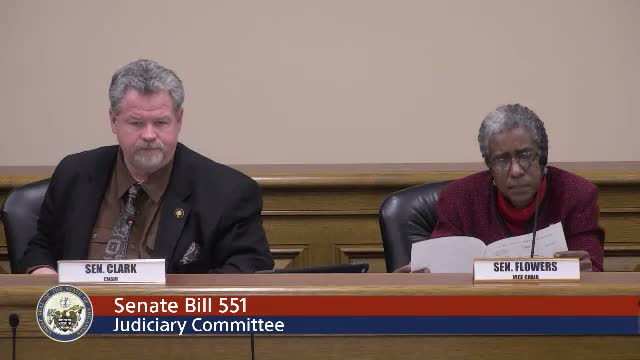
Senate committee clears bill to ease title problems for a North Little Rock church parcel linked to restrictive covenants
Summary
S.B. 551 would create a narrow process for burdened property owners to render certain older, widely-enforceable restrictive covenants unenforceable when identifying beneficiaries is impracticable; the committee passed the bill after lengthy questioning about notice and scope.
The Judiciary Committee passed S.B. 551, a measure sponsors described as targeted relief for property owners who cannot sell or repurpose a parcel because longstanding restrictive covenants—often created by successive bills of assurance—make it impracticable to locate every party with enforcement rights.
Senator English introduced the bill and called Grant Cox, an attorney for the property owner, to explain a Lakewood (North Little Rock) case in which a church parcel deeded for church use only reverted to an association but cannot be put to alternative uses because the original dedication and tacked-on bills of assurance create a tangled chain of enforcement rights. "The instrument...was brought in by a bill of assurance that tacked onto other bills of assurance...we couldn't trace back anymore to how many properties may have been benefited," Cox said.
Committee members pressed several points: whether surrounding property owners should be served notice of any expedited proceeding, how the bill treats instruments recorded more than 30 years ago, what relief is available to burdened property owners, and whether the legislation would inadvertently strip protections from long-standing covenants. Cox said the draft targets large cases (where the set of potential enforcers numbers 200 or more), provides for notice by publication or warning order when individual service is impracticable, and is not intended to automatically invalidate valid covenants held and actively enforced by a functioning property-owners association.
Dennis Wilkins, representing the association tied to the Lakewood church site, testified about the building's size, maintenance costs and inability to find a church buyer because of operational costs and deed restrictions. Supporters said the bill would clear title so property can be marketed or repurposed where feasible; critics urged adding explicit notice to adjacent owners and safeguards for sensitive uses (cemeteries and similar protected uses were raised as questions).
After extended discussion the committee moved, seconded and passed S.B. 551 by voice vote. Sponsor and supporters said the bill was carefully drafted to address large, legacy covenant problems rather than routine small-plot neighborhood restrictions.