Get Full Government Meeting Transcripts, Videos, & Alerts Forever!
Get email alerts on the Sb 279 Condemnation Fees topic
No spam. Unsubscribe anytime.
Senate committee debates changing how attorney fees are calculated in condemnation actions; fee proposal fails
Summary
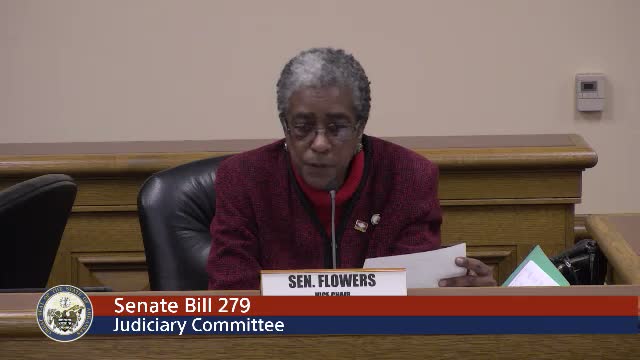
Senate Judiciary members debated S.B. 279, a bill that would require courts to calculate attorney fees in condemnation cases on an hourly basis rather than allow awards that resemble contingency fees; after extended questioning from members and witnesses, the motion to pass failed in committee.
A proposal to require hourly calculation of attorney fees in condemnation (eminent domain) cases drew extended committee scrutiny and failed in the Senate Judiciary Committee.
Senator Pich, the bill sponsor, told the committee S.B. 279 would replace a fixed or undefined award method with language specifying attorney fees be "calculated on an hourly basis," arguing that an hourly standard avoids arbitrary awards and is a better use of taxpayer dollars. "If it's not tied to an hourly rate, it ends up picking winners and losers," the sponsor said, adding that the change is intended to be "good stewardship with the taxpayer dollars."
Several senators argued existing law already requires courts to award "reasonable attorney's fees" when a jury award exceeds deposited funds by 20 percent, and questioned whether courts actually award contingency-style fees under current statute. Rita Looney, chief legal counsel for the Department of Transportation, told the committee the statute requires the court to award reasonable attorney's fees but that attorneys sometimes submit contingency-style fee agreements when petitioning the court. "We do see contingency fees submitted to the court for consideration," Looney said, adding that courts often enter an award stated as a dollar amount rather than explicitly labeling the basis.
Angela Evans, an ArDOT staff attorney, described cases where a jury verdict produced a large fee award that significantly exceeded the landowner's net recovery. She said she has seen instances where the department would have saved taxpayer money through earlier settlement but attorneys pursued trial because recovery of fees increased total compensation. Evans said one case produced $24,000 in attorney fees where the landowner's additional recovery over the deposit was roughly $14,000.
Opponents warned the change could restrict property owners' ability to recover reasonable fees and could disadvantage plaintiffs who rely on contingency agreements to pursue claims. Supporters said the change would add clarity and prevent outsized attorney awards that raise acquisition costs for public projects. After debate, the chair called a voice vote and the motion to pass S.B. 279 failed. The committee later agreed to expunge the record of that failed vote.
The transcript records voice votes only and no roll-call tallies for this item. The discussion centered on whether courts are currently permitting contingency-style awards despite statutory language and whether an hourly benchmark would be more consistent with ordinary fee petitions.