Get Full Government Meeting Transcripts, Videos, & Alerts Forever!
Get email alerts on the Committee Votes topic
No spam. Unsubscribe anytime.
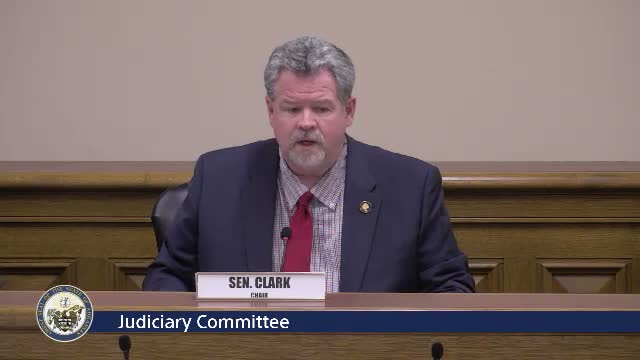
Judiciary Committee clears a package of public-safety and liability bills; privacy bill receives no action
Summary
The Senate Judiciary Committee passed a slate of generally noncontroversial bills on law‑enforcement definitions, school‑safety reporting, domestic‑violence confidentiality, hemp‑CBD, and liability reforms. A high‑profile privacy bill (SB230) drew lengthy testimony and received no action.
The Senate Judiciary Committee approved a series of bills covering law enforcement definitions, school‑threat reporting, domestic‑violence confidentiality, hemp/CBD regulation and a range of civil‑liability measures in a session that ended with no action on a contentious privacy bill.
Committee members began by moving quickly through several items the chair described as short and noncontroversial. SB9, sponsored by Senator Garner, was amended to clarify that certain federal investigators, including Social Security Administration staff who work with local police on fraud, would fall under the state's law‑enforcement umbrella; the committee passed the bill by voice vote. The committee also concurred in a House amendment to SB10 — narrowing the Halloween period covered, defining costume elements and adding a retail exemption — and passed the bill as amended.
House bills that the committee approved included HB1437, which adds categories of mandatory reporters for credible, serious and imminent threats targeted at schools; sponsors cited a Texas County program that, since 2018, recorded 24 complaints, 11 credible incidents and 13 arrests and said roughly 75 percent of those involved prior communications. Other passed bills included HB1550 (expanding the absconding offense for defendants who fail to return when bed space is available), HB1518 (aligning state code with the federal Farm Bill for hemp‑derived CBD and adding labeling requirements), HB1379 (making domestic battery statutes congruent and updating classifications for serious injury), HB1380 (confidentiality protections for advocates at recognized domestic violence shelters), HB1506 (penalties for removing items from grave sites), HB1497 (immunity for owners of stolen farm equipment analogous to auto law), HB1646 (adding railroad facilities to the state's critical‑infrastructure list) and HB1620 (liability rules and 'inherent‑risk' definitions for bicycle outfitters). Committee proceedings recorded voice votes and the chair announced motions carried on each of these items.
Senator Hammer's SB230, a statutory revision addressing intrusion and 'false light' invasion‑of‑privacy claims and setting pleading and proof standards, drew the most sustained attention. After adopting an amendment negotiated with press stakeholders, the committee heard hours of testimony both for and against the measure. Press organizations and defense groups warned the bill would lower protections for speech and spur litigation; proponents said the bill would provide clearer statutory guidance and remedies for reputational harm. A motion to move SB230 passed the maker but failed for lack of a second, and the chair declared no action — the bill may be brought up again.
What changed next: Most items on the agenda moved forward with committee approval; SB230 drew extended debate and public testimony and received no action, leaving its future pending further consideration on the floor or at a later committee meeting.