Get Full Government Meeting Transcripts, Videos, & Alerts Forever!
Get email alerts on the Sex Offender Registry topic
No spam. Unsubscribe anytime.
Committee debate over SB 351: narrow exceptions to sex-offender registration for close‑in‑age cases
Summary
Sen. Clark's SB 351 would prevent registration as a sex offender when the victim was 18 and the actor was within three years older and the court finds no force; prosecutors said Arkansas law already contains some three‑year affirmative defenses and warned that registration rules and out‑of‑state convictions complicate retroactive relief; the bill failed on a voice vote and committee expunged that vote.
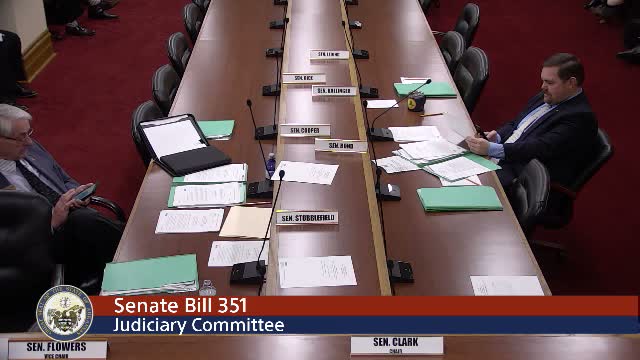
Senator Clark presented SB 351 to provide that a person would not be required to register as a sex offender when the victim was 18 and the actor was no more than three years older and when the court finds no evidence of force, compulsion, threat or intimidation. Clark said the bill responds to cases where consensual, close‑in‑age relationships have produced lifetime registration outcomes that sponsors consider unfair.
Prosecutorial witnesses and committee members noted that Arkansas law already includes a three‑year affirmative defense in several statutory sexual‑offense provisions when the victim is a minor, but they emphasized that registration is administratively separate from prosecution. Laurie Campuris, a prosecutor coordinator and member of the offender assessment committee, said the affirmative defense commonly applies when the victim is under the statutory age and within the three‑year gap; she cautioned that other sexual offenses may not include the same defense, and that registration consequences vary when convictions come from other states without comparable defenses.
Carla Swanson, representing Arkansas Time After Time, testified in favor and asked whether relief could be retroactive for people already on the registry; sponsor Clark said the draft is not retroactive and would apply prospectively. After debate, the committee voiced the motion to pass and the chair announced the bill "fails for the moment." Senator Clark moved and the committee approved expunging the failing vote so the measure can be reconsidered later.