Get Full Government Meeting Transcripts, Videos, & Alerts Forever!
Get email alerts on the Education Funding topic
No spam. Unsubscribe anytime.
Joint education committee approves 2024 adequacy study and backs higher health-insurance contribution for school employees
Summary
The joint House and Senate education committees approved the final 2024 adequacy study, endorsing increases in staffing FTEs, per-pupil funding and a Department of Education contribution to the Employee Benefits Division; the committee also recommended legislative action to raise district monthly payments for employee health insurance.
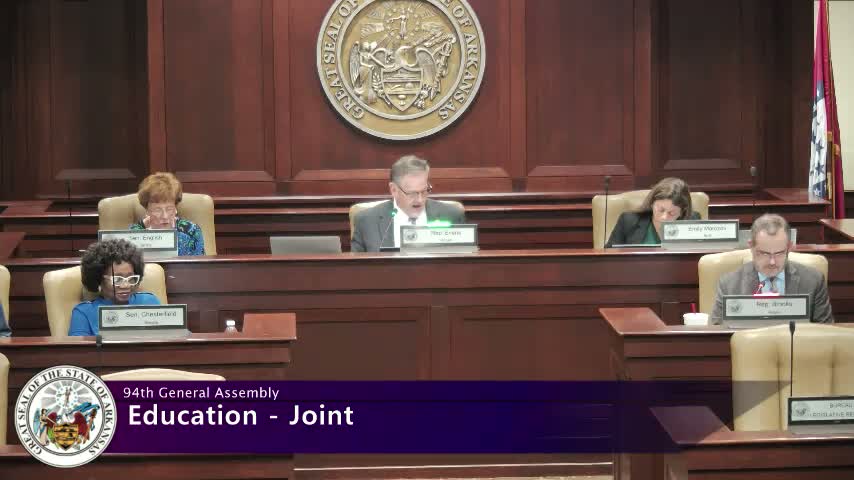
At a joint meeting of the House and Senate education committees, the committee approved the final 2024 adequacy study report and agreed to recommend state funding and a related health-insurance payment increase to legislative leaders.
The committee’s chair opened discussion by pointing members to handout No. 3, a proposed 2024 adequacy matrix compiled with staff and consultant input, and asked BLR staff who compiled monthly data to stand for recognition. “They spend a whole lot of time putting a whole lot of data together for us,” the chair said.
Representative Brooks moved to adopt the final adequacy study report, saying the recommendation “includes a line item for the Department of Education's contribution to the employee benefits division on behalf of educator health insurance for an amount of $150,600,000 in 2026, and $156,700,000 in 2027.” The committee took a voice vote and the motion passed; the recommendation will be forwarded to the governor, the speaker of the House and the president of the Senate on or before November.
The matrix adjustments the committee approved include staffing and funding changes the chairs summarized: special-education full-time-equivalent (FTE) staffing rising from 2.9 to 3.2; school counselors (listed in the matrix as guidance counselors) increasing from 1.11 to 1.61; a stated total recommendation for school-staffing FTEs of 36.51; and a per-pupil foundation funding level of $8,162 for the 2026 school year and $8,371 for 2027.
Most matrix items carry an annual cost-of-living adjustment of 2.48 percent; the chair said health-insurance costs are a pass-through set by the Employee Benefits Division (EBD) and thus increase overall salary figures. The committee also agreed to targeted increases meant to retain classified staff and improve substitute coverage: a $6-per-pupil increase in year one and $8 in year two for classified staff salary adjustments, and substitute funding of $7 per pupil in year one and $12 per pupil in year two.
On technology funding the committee reduced the per-pupil allocation by $15 annually to better align state allocations with districts’ actual technology spending, the chair said, noting many districts rely on federal grants for technology purchases.
Separately, the committee approved a motion recommending legislation to increase the monthly amount districts and charter systems pay to EBD for employee health insurance from $234.50 per participating member per month to $312. The motion also reflected matrix adjustments that increase the Department of Education’s payment to EBD from $142,000,000 to $144,800,000. The chair said EBD requested the increase to keep the insurance funds solvent and that legislation would be filed in the January session to make the change retroactive for the current school year.
Senator Chesterfield spoke in support and offered brief remarks thanking colleagues and staff for their work; the committee adjourned after the chair confirmed plans to submit the joint recommendation to state leaders and to meet again in December on higher-education topics.
Votes at a glance - Approval of August 20, 2024 minutes: voice vote; ayes carried. - Approval of final 2024 adequacy study report (including DESE/EBD contributions): motion by Representative Brooks; second recorded; voice vote passed. - Recommendation to increase district monthly EBD contribution (from $234.50 to $312) and related matrix amendment: motion made and seconded; voice vote passed.
The committee will send its recommendations to the governor and legislative leadership and plans a December meeting to address higher-education items.