Get Full Government Meeting Transcripts, Videos, & Alerts Forever!
Get email alerts on the Teacher Pay topic
No spam. Unsubscribe anytime.
Arkansas unveils $10 million merit teacher incentive to reward top performers, DOE says checks to issue this month
Summary
The Department of Education presented a Merit Teacher Incentive Fund design allocating $10 million for bonuses (up to $10,000) to high‑impact licensed teachers, using value‑added growth measures for tested subjects and an evaluation/stackable model for others; DOE estimated about 3,000 teachers (top 10%) will receive awards.
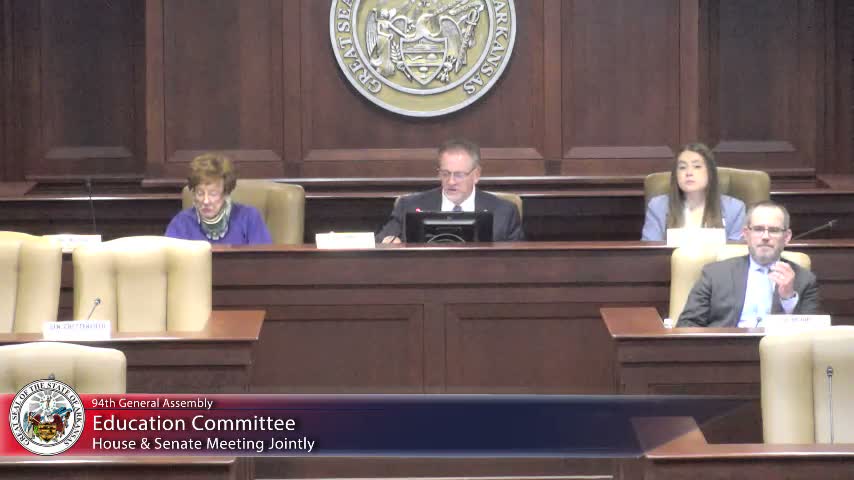
The Arkansas Department of Education gave the Joint Education committees an overview of the Merit Teacher Incentive Fund that the Legislature funded as part of the Arkansas Learns agenda.
Secretary Jacob Aleve and Assistant Commissioner Carly Saracini said the Legislature allocated $10,000,000 to reward teachers who demonstrate sustained, above‑expected student growth or other documented professional impact. For tested subjects the program relies on a three‑year value‑added measure (VAM); teachers in the top growth percentiles are eligible for the larger awards. The DOE described a stackable model to include non‑tested teachers, counselors and specialist staff by combining strong annual evaluations and other contributions—mentoring, work in hard‑to‑staff regions or critical‑shortage areas, or master‑teacher portfolio designations.
DOE officials showed committee members an eligibility map and said the finalized rules were adopted by the State Board of Education and will come before the committee in June. They said districts will validate data for accuracy and the department expects to begin issuing checks by the end of the month once rules are promulgated and data are verified.
Key design points cited by DOE: - Top tier awards: DOE identified approximately 40 teachers who would meet the highest VAM threshold and be recommended for the full $10,000 award. - Tiers and targeting: additional tiers were built so teachers meeting lower—but still high—growth thresholds receive proportionally smaller awards (DOE cited examples at the $9,000 level in internal charts). DOE estimates about 3,000 teachers—roughly the top 10% statewide—will receive some award from the $10M pool. - Eligibility constraints: teachers must be licensed to qualify; unlicensed employees (including those on waivers or emergency permits) are excluded in year 1; DOE estimated ~12% of instructional staff are currently unlicensed under various waivers and permits. - Non‑tested teachers: where statewide growth data are not available (for example, early‑grade, arts or specialist positions), highly effective annual evaluations and other stackable factors will create pathways to eligibility.
Committee members voiced questions about baseline data for K–2 teachers, whether district‑level incentive plans will layer onto the state program, and how the incentive intersects with other LEARNS Act initiatives and a pending referendum discussed by members. DOE said this is year‑one baseline design; they expect to incorporate a unified progress‑monitoring system next school year to expand quantifiable measures for non‑tested grades.
Chair direction: the committee moved the teacher recruitment and retention item to August to gather 30–45 days of implementation feedback on the Merit Fund, and bureau staff will collect and forward member questions and any observed issues after the initial distribution.
No vote or appropriation action occurred during the presentation; the session was informational and DOE offered to return with implementation updates.