Get Full Government Meeting Transcripts, Videos, & Alerts Forever!
Get email alerts on the Free Speech Higher Ed topic
No spam. Unsubscribe anytime.
Committee debates bill to extend campus free‑speech protections indoors; motion to advance fails
Summary
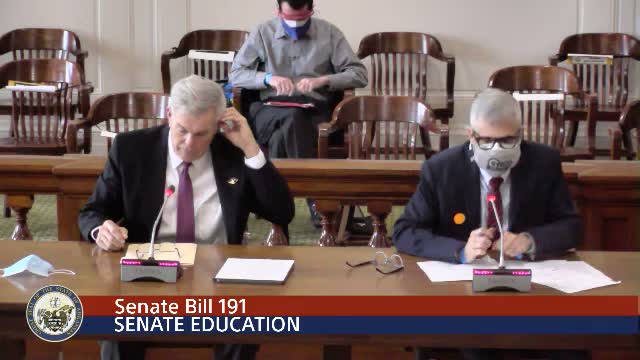
Lawmakers and witnesses debated Senate Bill 191, which would expand protections from the 2019 Forum Act to some indoor common areas and increase statutory protections for faculty and staff; the committee did not advance the bill after a 'motion to pass' failed for lack of a second.
Senate Bill 191, titled the Free Thought in Higher Education Act in testimony, drew lengthy testimony and questioning before the Senate Education Committee but did not win a committee vote.
Senator Dan Sullivan, who introduced the measure, said the bill builds on the 2019 Forum Act by expanding protected expressive activity to include certain indoor common areas and by clarifying that protections can extend to faculty and staff as well as students. "It just talks about the rights to free speech of members of campus communities," he said in opening remarks, and emphasized that universities would retain authority for reasonable time, place and manner restrictions.
Robert Steinmach, a law professor who testified in his individual capacity, told the committee the changes are incremental and that the bill preserves prohibitions on illegal conduct: "No illegal activity, no disruption. It's all in the bill," he said. He and supporters argued the bill would protect extramural speech — such as political posts or conduct off campus — that some public employees have been disciplined for.
Opponents raised concerns that the language could sweep into classrooms, hallways or repurposed campus spaces and complicate campus operations. Brad Phelps, general counsel for the Arkansas State University System, warned the bill could be broader than intended: "I do believe that could include classrooms. I do believe that could include hallways," he said, citing COVID‑era repurposing of campus space as a practical complication.
Committee members pressed witnesses on where federal civil‑rights laws — including Title VII and Title IX — would continue to limit protected speech. Proponents emphasized those federal laws remain applicable and that universities retain tools to address harassment and material disruption. Josh Silverstein, a law professor who testified in support, said the First Amendment is a floor and state law may permissibly extend protections for speech by public employees.
After extended questions and closing remarks, a member moved that the bill "do pass"; the motion failed for lack of a second and the measure did not advance out of committee.
The committee did not adopt any substitute language during the hearing; sponsors indicated they would continue to work with universities and stakeholders.