Get Full Government Meeting Transcripts, Videos, & Alerts Forever!
Get email alerts on the Professional Learning Communities topic
No spam. Unsubscribe anytime.
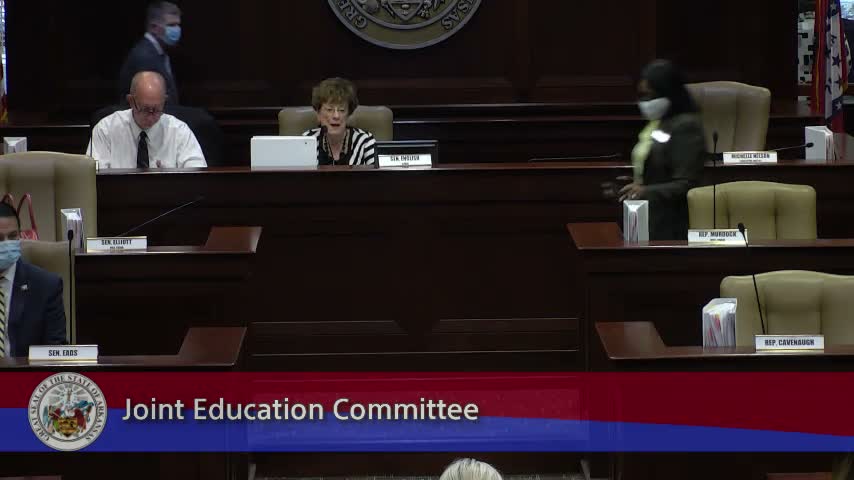
Principals tell senators PLC coaching, collaboration led to test-score jumps and fewer referrals
Summary
Principals and teachers told the Senate Education Committee that state-funded Professional Learning Communities (PLCs), implemented with Solution Tree coaching, produced measurable gains — in some schools tripling grade-level proficiency and reducing disciplinary referrals — and that DESE is working to scale and sustain the approach statewide.
Principals and teachers representing PLC pilot schools told the Senate Education Committee that giving educators protected time to collaborate, plus outside coaching, has produced notable gains in student learning and school climate. The witnesses, who testified across the committee’s hearing, urged continued support and wider access for schools that want to adopt PLC practices.
Kalisha Glover, principal at Mabelville Elementary School, described the school’s PLC grant work and the schedule changes that created teacher collaboration time and a schoolwide intervention block. She said Mabelville serves about 475 students (approximately 64% African American, 26% Hispanic and 7% white/other) and credited PLC coaching with reducing disciplinary referrals to 32 for the year, under a goal of 60.
Josh Ray, principal at Eastpoint Elementary in Greenwood, described dramatic reading gains he attributed to PLC practices: "we found out that only 4 percent of our third grade students were proficient in reading. In 2 years, that number's increased to 36 percent," he told the committee. Ray said PLC work forced adults to examine instructional choices and biases and argued the state’s investment is producing teacher leaders and district-level spread of the model.
Robin Dawson, principal of Spradling Elementary in Fort Smith, characterized PLCs as a life-changing culture shift. She described a school with extremely high poverty and a largely non–English-speaking home population and said Solution Tree coaching helped the staff establish a guaranteed curriculum and stronger intervention systems. "You didn't change lives when you made the change to fund this program. You saved a life," Dawson said.
Multiple lawmakers pressed for evaluation details. Senator Chesterfield asked whether PLCs have summative evaluations; witnesses said Education Northwest conducts evaluations and that full three‑year summative results are pending for the earliest cohorts (some results were delayed because statewide testing was disrupted by COVID‑19). DESE officials and principals described a multi-pronged scaling strategy: statewide guiding coalitions, grade-level teams, monthly webinars and district buy-in; they also said cohort selection is competitive (applications rose from the dozens to nearly 97 applicants for cohort 4) and that roughly 10 districts have completed the three‑year cohort cycle so far.
Committee members raised concerns about sustainability and transferability. Representative Allen asked how many districts saw letter-grade improvements; panelists said some districts, including schools in Fort Smith, reported letter-grade gains but cautioned that only a subset of districts is three years into the work, and statewide, outcomes vary with leadership and commitment. Panelists emphasized that PLC success depends on adult disposition and leadership, not simply buying a contract: schools that resist the required changes sometimes drop off, while others sustain the work after coaches exit by embedding PLC practices into school culture.
Several witnesses described operational details: schools reallocated master schedules to provide daily protected planning time (about 40 minutes per day in many examples, with one day of extended collaborative time), used data to group students for interventions, and shifted toward inclusion practices for special‑education students. Panelists said the PLC model has been used across elementary through high schools in pilot districts and that some higher‑education teacher‑prep programs are being asked to incorporate PLC-related content into syllabi.
The committee closed the PLC testimony by thanking participants and asking DESE for follow-up data on outcomes and the evaluators’ summative findings. The session then moved to a separate agenda item on a cleanup bill affecting school reporting.