Get Full Government Meeting Transcripts, Videos, & Alerts Forever!
Get email alerts on the Esa Funds topic
No spam. Unsubscribe anytime.
Arkansas district survey shows teachers, coaches and counselors ranked highest uses of ESA dollars; spending patterns vary
Summary
APA presenters told the Senate Education Committee that district survey respondents rated classroom teachers, curriculum specialists and counselors as the most effective uses of Enhanced Student Achievement (ESA) funds, but statewide ESA expenditures show transfers to other categoricals and uneven alignment with stated priorities.
Arkansas Department of Education (ADE) funding for low-income pupils known as Enhanced Student Achievement (ESA) funds was the focus of an APA presentation Tuesday to the Senate Education Committee. The consultant team said a July district survey produced 81 responses — representing roughly 72% of school districts and 48% of charter systems — and that respondents ranked classroom teachers, curriculum specialists and coaches, and counselors/social workers/nurses as the most effective ESA uses.
"Fifty-seven percent of respondents rated classroom teachers as most effective," APA presenter Micaela Tonkin told the committee. She said respondents also rated curriculum specialists and instructional coaches highly and that 82% considered counselors, social workers or nurses to be effective or most effective uses of ESA funds.
The presentation included a comparison of survey perceptions with FY19–20 expenditure data compiled by the Bureau of Legislative Research. Tonkin said curriculum specialists and instructional facilitators accounted for about 16% of statewide ESA expenditures, counselors/social workers/nurses about 14%, and transfers to other categorical funds about 12% of ESA dollars. She noted several categories that respondents rated as effective — including before- and after-school programs, remediation and pre-kindergarten — received under 5% of ESA spending in the examined year.
Committee members pressed presenters on interpretation limits. Representative Meeks asked whether a program labeled "not effective" in the survey might simply be one districts were not funding out of ESA; Tonkin said the study did not cross-tabulate every “not effective” response with the actual expenditure line and cautioned against drawing causal conclusions from the data. "We did not run to see if there was the comparison," Tonkin said.
Senators and representatives also asked about transfers from ESA into other categoricals. APA staff said common transfer destinations included professional development, English-learners funding and Alternative Learning Environments (ALE). The presenters said the team is still cataloging specific "other activities approved by ADE" and will include a fuller breakdown in the final report.
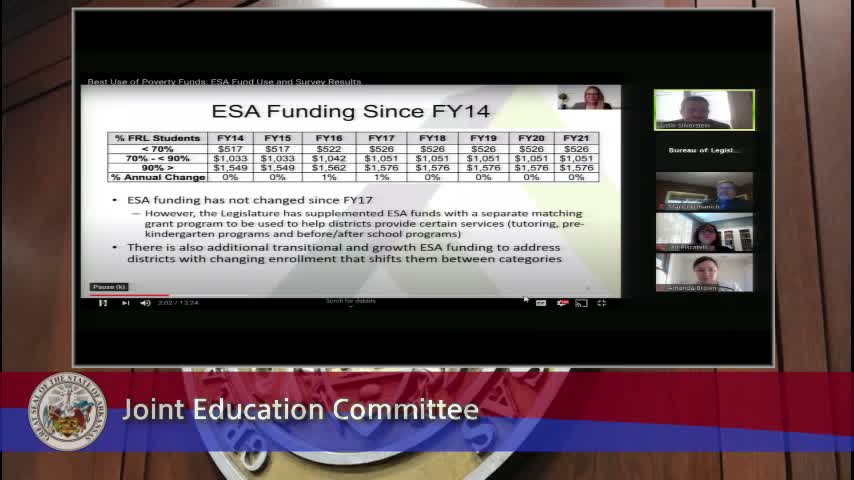
The committee was also reminded of ESA funding tiers shown in APA materials: an example table in the presentation listed per-student ESA allocations of roughly $526 for districts under 70% free-and-reduced-lunch concentration and $1,576 for districts above 90% concentration; presenters said ESA per-student amounts have not changed since 2017.
The presenters and committee members agreed that the survey offers a useful snapshot of district perceptions but that additional cross-tabulation with spending and program outcomes would be needed before making prescriptive policy changes. APA said it will bring additional detail in upcoming case-study presentations scheduled for the committee’s next meeting.