Get Full Government Meeting Transcripts, Videos, & Alerts Forever!
Get email alerts on the Case Studies topic
No spam. Unsubscribe anytime.
APA case studies: small schools, intensive RTI, strong community ties linked to improvement
Summary
APA consultants told the Senate Education Committee that high-performing schools in their case studies shared common practices — smaller enrollments, data-driven RTI, scheduled intervention blocks, common planning time, community partnerships and leadership that distributed responsibility to teachers.
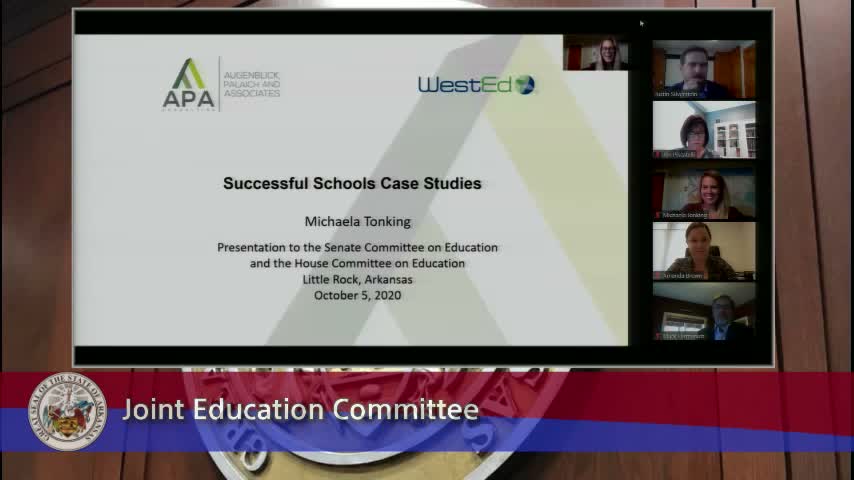
Mikayla Tonkin, an APA consultant, told the Senate Education Committee that APA’s 15 case-study schools were selected for outperforming expectations and then filtered by criteria such as recent improvement, at least 8% English-learner enrollment or at least 63% low-income students.
Tonkin said the case studies spanned regions and school levels and that many of the higher-performing schools were relatively small — APA reported that 21% of the case-study schools averaged about 361 students, below the matrix model of 500. She said staffing models varied, but successful schools commonly used instructional facilitators, paraprofessionals and flexible specials teachers to deliver targeted supports.
"There was a strong RTI support," Tonkin said, describing tiered interventions (tier 1 general instruction, tier 2 small groups/push-in, tier 3 pull-out one-on-one) and frequent interim assessments used to move students in and out of targeted tiers. She also said the schedule often included long core-instruction blocks (up to 90 minutes) plus embedded days for intervention and enrichment, and that many schools scheduled common planning time for staff collaboration.
Tonkin highlighted noninstructional factors that recur across case studies: strong community partnerships providing donations and volunteers, on-site health clinics or mental-health services through community providers and Medicaid, and leadership practices that treated teachers as professionals with autonomy and shared decision-making. She cited advisory/mentoring practices in which teachers tracked small caseloads of students across years as a relationship-building strategy.
The presentation was descriptive rather than causal. During questions, APA's Justin Silverstein said the mentoring example came from a single school intended to illustrate broader patterns; he emphasized that the case studies are illustrative and that "every school is doing it a little differently." APA agreed the detailed school write-ups will include the specific local evidence.
The committee asked follow-up questions about operational details, including whether students could choose mentors; APA said models varied across schools and that some used advisory periods or multi-year teacher-student consistency.
The committee will receive full school write-ups and return to the topic in future meetings as APA prepares its recommendations.