Get Full Government Meeting Transcripts, Videos, & Alerts Forever!
Get email alerts on the School Reopening topic
No spam. Unsubscribe anytime.
Arkansas outlines testing, quarantine and tracing plan as schools reopen
Summary
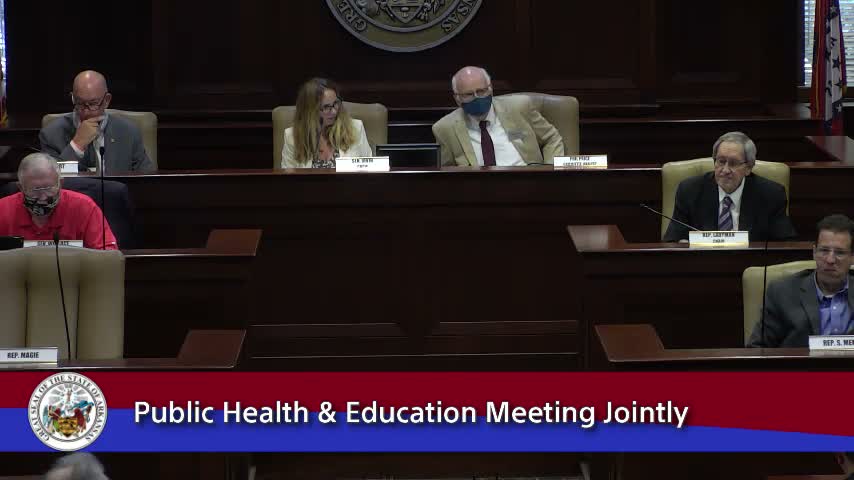
Arkansas education and health officials told a joint legislative committee they will prioritize point-of-contact reporting, PCR confirmation of antigen results and rapid contact tracing for school cases, but they declined to set a single statewide closure threshold, favoring context-specific decisions.
Arkansas education and health officials told a joint Senate Education and Public Health committee on Monday that districts should identify a trained point of contact to report suspected COVID-19 cases, that initial antigen screenings will be confirmed or followed up with PCR testing, and that contact tracing will begin promptly when a positive result is confirmed.
Johnny Key of the Arkansas Department of Education said the state provided a “playbook” and resources to help districts address interrupted learning and operational challenges, and that the department has reserved a portion of ESSER/CARES funds to supply PPE and technology. Key said districts received a mix of direct ESSER payments and a state-held 10% reserve for emergency needs.
Dr. Romero of the Arkansas Department of Health described the clinical pathway: students with symptoms should be sent home and evaluated by a primary care provider; rapid antigen testing may be used as an initial screen and “we will back that up with a PCR test,” he said. He added that a positive PCR result triggers the state’s contact-tracing cascade and quarantine protocols.
The health department said it will prioritize school specimens through a state courier and public-health laboratory system, deploy strike teams for mass testing where local rapid machines are unavailable, and allocate rapid machines to local health units as supplies permit. Romero said the state planned an initial distribution of rapid machines (40 immediately, with 120 machines as the first allocation) and intends to place machines at local health units as availability allows.
On whether antigen-positive results would count in official figures, Romero said the state currently treats antigen positives with caution and is following CDC and Council of State and Territorial Epidemiologists guidance; the department said it will capture antigen results to inform policy, even if definitions change. He also stressed the limits imposed by testing turnaround time: lab delays at commercial vendors can impede timely contact tracing, while specimens tested in the state lab aim for a 24–36 hour turnaround.
Lawmakers pressed for clear triggers that would force campus closures, but both leaders declined to set a single numeric threshold. “There is not a specific trigger that would require a closure of a school,” Key told the committee, saying decisions will be made case-by-case in coordination with public-health investigators and district leaders. Dr. Romero said contact investigators determine who meets CDC-defined close‑contact criteria (within 6 feet for 15 minutes or more) and who must quarantine for 14 days.
Officials emphasized operational support for vulnerable staff and students: districts are expected to offer virtual options and reasonable accommodations for medically fragile teachers and students, and ADE said districts will receive templates and screening kits to use as needed. Key urged districts to pair mitigation layers—masking, hygiene, distancing and ventilation—rather than rely on any single measure.
The committee’s discussion made clear the administration’s approach: provide tools, prioritize school-associated specimens, and make locally informed decisions rather than impose a single statewide closure metric. The state also highlighted investments in lab capacity, additional contact tracers, and strategic distribution of PPE and testing equipment as the school year begins.