Get Full Government Meeting Transcripts, Videos, & Alerts Forever!
Get email alerts on the Funding Models topic
No spam. Unsubscribe anytime.
Consultants model alternatives for growth and declining‑enrollment funding; 3‑year averaging would greatly increase state cost
Summary
Presentation outlined Arkansas’ prior‑year funding approach and modeled alternatives: a 2% growth threshold would reduce the number of districts receiving growth funding; a 3‑year weighted average or simple 3‑year average for declining enrollment would substantially increase funded students and add tens of millions in costs compared with current rules.
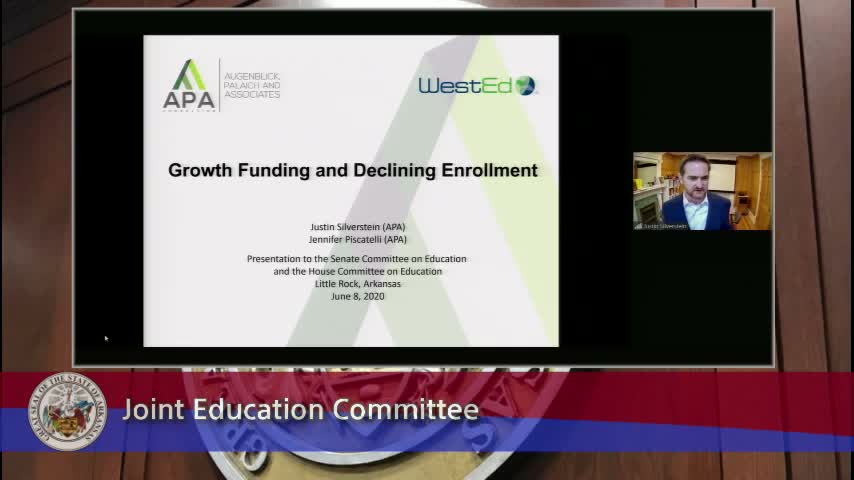
Presenters reviewed how Arkansas funds districts on prior‑year student counts and explored alternative approaches to growth and declining‑enrollment funding used in other states. Justin Silverstein explained the policy rationale: prior‑year funding aids budgeting predictability, while growth and declining adjustments are intended to cushion districts that are rapidly changing in enrollment.
The team modeled several alternatives. Using a Tennessee‑style 2% minimum growth threshold would shrink the set of districts receiving growth funding by roughly half and cut the modeled growth funding by about a third in most years. Conversely, moving to a 3‑year rolling average or a weighted average (for example, prior year = 50%, two years back = 30%, three years back = 20%) for declining‑enrollment adjustments would substantially increase the number of students funded and add material cost: presenters said a simple 3‑year average could require more than $20 million in additional funding in recent years compared with the current approach.
Consultants emphasized tradeoffs: a shift to current‑year funding improves alignment with enrollment in the present but makes budgeting and cash flow harder for districts; averaging or weighting smooths year‑to‑year volatility but increases state obligations. Justin said the team will engage stakeholders before making recommendations and help model transitions and thresholds that guard against large unintended fiscal consequences.
Committee members asked the team to model current‑year funding and to examine options for reconciliation, noting impacts on small and rural districts can be acute. Presenters agreed to add further modeling and stakeholder outreach as part of the study’s next phase.