Get Full Government Meeting Transcripts, Videos, & Alerts Forever!
Get email alerts on the School Finance topic
No spam. Unsubscribe anytime.
Consultants warn shifting poverty proxies, CEP participation could move millions in state aid
Summary
APA’s study team showed that adopting direct certification or other alternative poverty counts — or rising participation in the Community Eligibility Provision (CEP) — would materially change the distribution of Arkansas’ at‑risk counts and could raise or lower ESA formula costs by millions, depending on district participation.
The Senate Education Committee heard detailed modeling showing that alternative poverty proxies — and community eligibility provision (CEP) participation — can produce large redistributions of state aid.
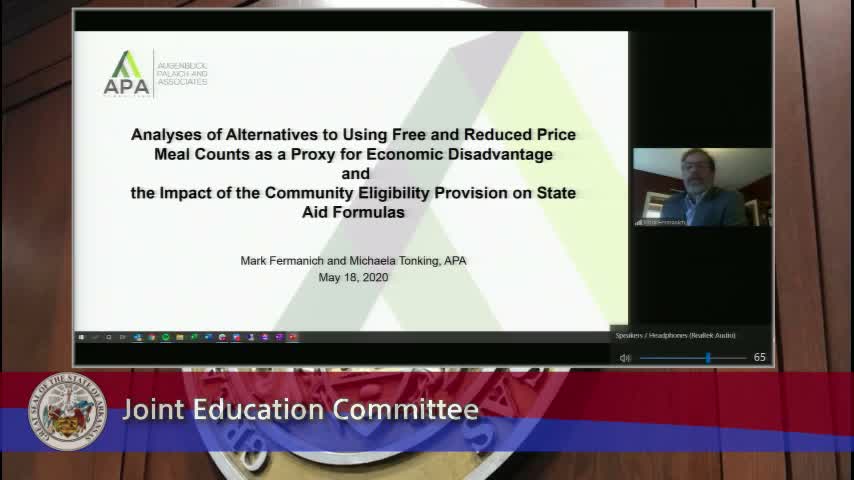
Mark Fermanek and colleagues presented five alternative counts tested for Arkansas: straight direct certification; direct certification scaled by a federal multiplier (1.6) and an alternative multiplier (2.1); the U.S. Census poverty count for children ages 5–17; and a Title I‑style count that mixes census poverty with individual risk factors. They showed that direct certification alone typically reduces counts statewide versus the current free and reduced‑price lunch (FRPL) measure, but that applying a multiplier (2.1) can approximate current statewide totals while preserving different district shares.
Mikaela Tonkin presented CEP participation figures and fiscal scenarios. She reported 57 Arkansas districts and 293 schools were using CEP, serving roughly 285,000 FRPL‑eligible students and roughly 478,000 students receiving meals through CEP. Using observed differences between CEP districts and near‑eligible non‑CEP districts, the consultants estimated that current CEP participation produced a net change in FRPL counts equivalent to a statewide savings of about $2.85 million in ESA aid; if an additional 69 near‑eligible districts all adopted CEP, the consultants estimated an $10.7 million increase in ESA costs (scenario scaling shown for 10% and 50% participation rates as well).
Representative Mark Lowery pressed the consultants on CEP mechanics and how Arkansas currently calculates tiers; consultants explained Arkansas applies prior‑year FRPL percentages and has growth adjustments for increasing enrollments. Consultants described state responses in other jurisdictions (California’s four‑year re‑count, Maryland’s use of prior full‑year data and a 0.97 weight, Tennessee’s per‑pupil add) and stressed that any shift in count methodology will create winners and losers across districts.
Consultants recommended further district‑level analysis and a policy discussion about the state’s objectives — whether to preserve current statewide funding totals, tighten the definition of poverty, or protect district shares — before any change to the proxy or to ESA weights.