Get Full Government Meeting Transcripts, Videos, & Alerts Forever!
Get email alerts on the School Funding Formulas topic
No spam. Unsubscribe anytime.
Committee hears how student-growth and declining-enrollment formulas interact and affect district budgets
Summary
Bureau staff reviewed how student-growth funding (quarterly) and declining-enrollment funding (prior‑year ADM formula) are calculated, highlighted unpredictability in growth payments and noted that declining-enrollment plus prior-year foundation funding can yield roughly 1.5 times the foundation rate for lost students.
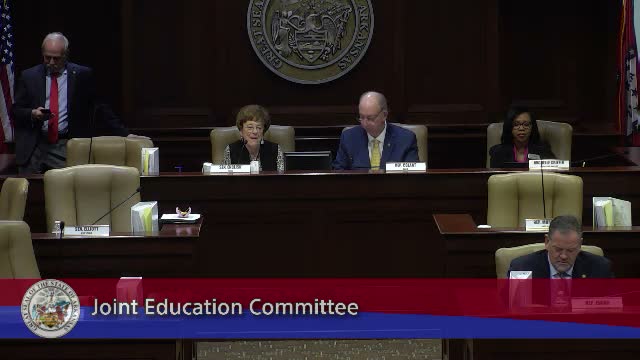
Adrienne Beck and Elizabeth Bynum of the Bureau of Legislative Research presented the committee with an overview of student-growth and declining-enrollment funding.
Beck explained student-growth funding was created in 1995 (Act 917) to supplement foundation funding for newly enrolled students because foundation funding is based on prior-year ADM. She described how Act 741 (2017) changed calculation timing and introduced a provision that reduces student-growth payments for districts that generate excess revenue through the uniform rate of tax (URT). Beck noted student-growth funding is unpredictable because it relies on quarterly ADM changes and that some districts and charters receive substantial growth payments (Bentonville and Arkansas Virtual Academy topped the list in a recent year).
Bynum explained declining-enrollment funding (created after the Lakeview litigation via Acts 20 and 21, first extraordinary session of 2006) uses a formula that averages the two prior-year ADMs and subtracts the previous year ADM, then multiplies by the foundation funding amount. Because foundation funding continues to be paid on prior-year ADM while declining-enrollment payments are added, a district that loses students can temporarily receive funding equivalent to about 1.5 times the foundation rate for each lost pupil under current formulas. Bynum walked through tables showing that Pine Bluff and Little Rock were among the largest declining‑enrollment recipients in the most recent period and that districts and charters generally used these funds for regular instruction, operations, and transportation.
Members asked whether the department can track where departing students went and whether overlapping eligibility (e.g., special-needs isolated funding vs. declining-enrollment) can be reconciled. Bynum said DESE rules award whichever funding yields the greater amount and that the bureau does not have a statewide method in the materials presented to trace individual student flows between sectors.
No formal votes were taken; the committee requested follow-up data to better understand student flows and potential policy changes to address perceived efficiency and equity issues.