Get Full Government Meeting Transcripts, Videos, & Alerts Forever!
Get email alerts on the Waivers topic
No spam. Unsubscribe anytime.
Staff: Arkansas public schools operate under thousands of waivers; committee asks for detailed lists
Summary
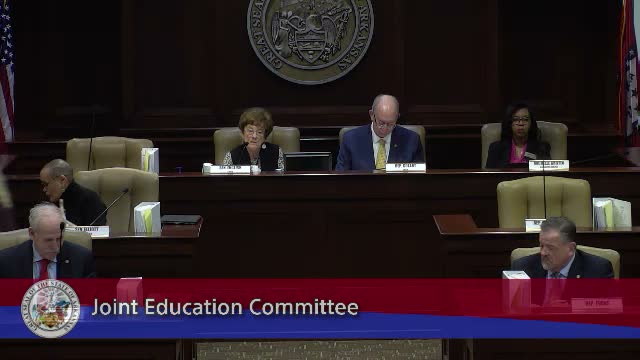
Bureau analyst Julie Holt told the Senate committee that Arkansas public schools are operating under more than 10,000 waivers from state laws and rules, with 97% of students attending schools under at least one waiver; members requested district- and school-level waiver inventories and counts of denied requests.
Julie Holt, legislative analyst with the Bureau of Legislative Research, told the Senate Education Committee that state education records show more than 10,000 waivers from Arkansas statutes and rules in effect and that about 97% of public-school students attend a school operating under at least one waiver.
Holt traced the growth in waivers to successive statutory pathways: conversion charters (mid-1990s), open-enrollment charter expansion, the 2013 school-of-innovation pathway, Act 12-40 (district access to charter waivers), and the more recent Act 8-15 that expanded access further. She said many waivers arise from charter systems that operate multiple campuses and that open-enrollment charter systems average more than 70 waivers each.
Holt described how she categorized waivers for analysis (curriculum, teacher pay/licensure, teacher work-environment, student services, administrative) and reported statistical findings using 2017–18 school-year data. Across the full sample, differences were often not statistically significant, but within the committee's high-poverty band Holt said schools without waivers were more likely to achieve above-average index and achievement scores; in some teacher-work-environment waiver comparisons the gap was large and statistically significant.
She flagged one dominant waiver used widely by districts: the law fixing the school start date (the common waiver allowing a school-year start when the calendar makes the statutory date difficult to meet). Removing that waiver from her counts reduced the number of districts operating under any waiver to about 118 (roughly 500 schools). Holt also noted a recent DESE emergency rule tied to a $60 million pot intended to help districts meet a rising minimum-teacher-salary target: schools with waivers from the minimum-salary law may be ineligible for that targeted money.
Committee members asked for follow-up: several requested district-level waiver tallies, a full inventory of waivers by district and school, lists of waivers that were denied and reasons for denial, and further analysis of whether waivers are renewed repeatedly. Holt agreed to provide the requested data.
The committee did not vote on legislation; members signaled interest in further study and requested concrete lists and district counts to guide any statutory changes.