Get Full Government Meeting Transcripts, Videos, & Alerts Forever!
Get email alerts on the Education Funding Review topic
No spam. Unsubscribe anytime.
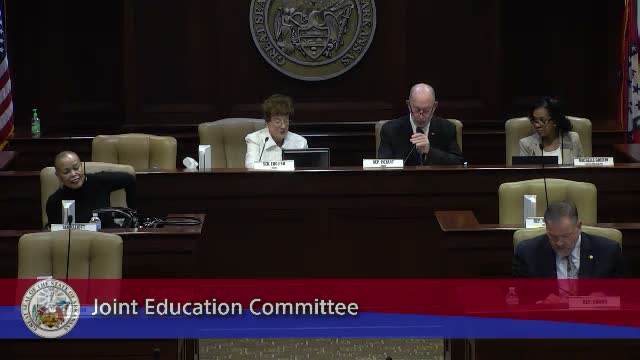
Arkansas Senate Education Committee debates hiring outside consultants; informal poll favors one study
Summary
Members of the Senate Education Committee spent a day debating whether to commission outside consultants to review K–12 adequacy and the state funding matrix after a subcommittee moved to forward two contracts. An informal, nonbinding poll of members favored commissioning one study.
The Arkansas Senate Education Committee met for a special session to discuss whether to hire outside consultants to review school funding adequacy and the state’s funding matrix after a subcommittee action sent two consultant contracts to ALC.
Chairing the meeting, the chair said the purpose was discussion, not a formal motion, and asked members to avoid personal attacks while weighing three options: no outside consultant, a single consultant, or two consultants. "This is not about a motion today," the chair said, asking members to focus on solutions for Arkansas students.
Members divided along two broad lines: those who urged commissioning outside expertise to bring new data and comparative lessons, and those who pressed the committee to rely on existing internal data and staff analysis. Senator Elliott argued for caution about expecting a full "study" where law limits the Legislature to a "review," and she urged the committee to rely on deliberate, well-sourced information drawn from work such as prior NCSL reviews and SREB comparisons. Representative Lowry and others said the Bureau of Legislative Research (BLR) and existing data could support targeted modeling — for example, testing the funding matrix on a 350‑student hypothetical instead of the current 500‑student baseline — without contracting out a large, expensive effort.
Several members criticized the process that moved two contractor bids forward. Representative Dela Rosa said she was "very frustrated" that ALC overruled the standing committee and that the result would ask taxpayers to spend "$1,300,000.0 on 2 contracts." She urged greater transparency, proposing that any time an individual legislator pushes a contract a clear, open motion should be recorded so the public knows who requested it.
Others warned of legal risk from commissioning competing consultant reports. Senator Chesterfield said having two opposing outside analyses could leave the state vulnerable in court over adequacy questions because the state would then effectively be financing expert witnesses on both sides.
Members who favored outside review — including leaders who cited experience with SREB and national comparisons — said outside consultants can bring world‑class perspective and help the state move beyond incremental fixes. Representative Lowry and Representative Lowry (and others) countered with historical examples where consultants led to policy failures (citing the "open classroom" design and problems with PARCC testing) and argued that political follow‑through, not just new reports, is necessary to implement change.
Senator Hammer asked staff whether contractor references were checked across all claimed states; staff said they had not verified every referenced engagement. The chair estimated that doing the work in‑house — traveling, meeting weekly and dedicating staff time — could cost an estimated $300,000–$500,000 in per diem and staff time, a figure members said should be weighed against contract prices.
The committee closed with a nonbinding, in‑room show‑of‑hands to capture preferences (not a formal vote). The chair recorded three members preferring no outside study, 13 preferring one study, and two preferring two studies. The chair said he would poll absent members by phone and reconvene or schedule next steps as needed. He also announced an 11:00 follow‑up session with an expert on dyslexia screening and reading‑at‑grade initiatives.
What happens next depends on the chair’s outreach to absent members and any subsequent scheduling decisions. The meeting adjourned after the chair confirmed the counts of the informal poll and set a separate hearing on dyslexia screening.