Get Full Government Meeting Transcripts, Videos, & Alerts Forever!
Get email alerts on the Education Funding Adequacy topic
No spam. Unsubscribe anytime.
Senate Education committee hears adequacy study testimony; educators press for sustainable teacher pay, special‑ed funding and pre‑K coordination
Summary
Presenters urged lawmakers to update the 2003 funding matrix, plan for a projected teacher-pay funding cliff, fully fund catastrophic special‑education costs and bridge pre‑K to kindergarten, while noting growth in career‑technical programs and broadband investments. (Summary of an Education Committee hearing.)
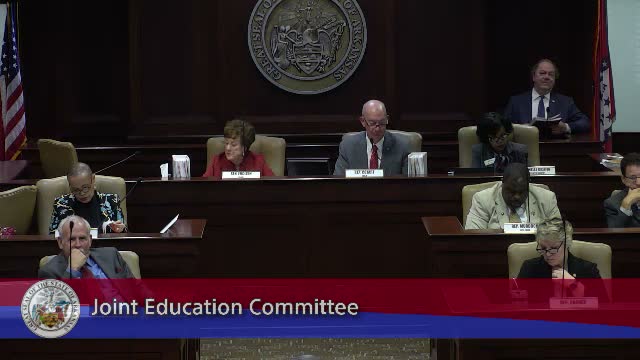
The Senate Education Committee on Tuesday heard testimony and written submissions aimed at informing a statutorily required adequacy study, with educators and advocates urging lawmakers to update the state funding matrix, protect teacher pay gains and increase funding for special education and early‑childhood programs.
Richard Abernathy, testifying for an education advocacy group, said Arkansas has “done a good job” in recent years on initiatives such as professional learning communities, the RISE reading initiative and expanded career‑technical partnerships, but warned that the funding matrix adopted in 2003 is outdated. “There is a concern about the teacher raise. What happens in four years on the funding cliff,” Abernathy said, urging the committee to commission unbiased research before making major policy changes.
Why it matters: Lawmakers are updating an adequacy study that will guide fiscal‑year funding decisions, including whether one‑time or phased state dollars that supported recent teacher‑salary increases should be continued. Several presenters said decisions on the purpose and allowable uses of ESA and other flexible funds must be made by the legislature and informed by current research.
Presenters and union leaders pointed to multiple funding pressures. Tracy Ann Nelson, executive director of the Arkansas Education Association, told the committee the association supports the adequacy review and cautioned that temporary pay increases could lapse unless the matrix or ongoing revenue sources are adjusted. “We do worry… what that will look like going forward once that funding is discontinued,” Nelson said.
Special education, pre‑K and behavioral supports featured prominently. AEA president Carol Fleming and other witnesses cited a 2016 special‑education task force estimate that Arkansas needs roughly $20 million more annually to meet catastrophic special‑education costs. They described high per‑student costs for devices and services — an augmentative communication device can range from $3,000 to $9,000, one witness said — and urged full funding for services required under federal law.
Committee members asked about the closure of day‑treatment centers and how districts are absorbing those students without extra funding. Abernathy said those services are increasingly the responsibility of local school districts and co‑ops and that the added costs are already being absorbed by districts.
On early childhood, members and presenters urged better coordination between pre‑K and kindergarten. ADE attorney Courtney Solis Ford told the committee that public preschools must assess children for disabilities and, if identified under IDEA, provide required services; private preschools that accept federal funds have related obligations. Members raised transportation and service‑continuity concerns for children who previously received supports through now‑closed day‑treatment programs.
Speakers also touted pockets of progress: expansion of concurrent college credit, growth in computer‑coding enrollment (from about 1,100 to nearly 10,000 students since 2014, as a presenter reported), and a $25,000,000 statewide broadband investment to improve school connectivity.
What lawmakers asked for: Committee members repeatedly requested targeted research from presenters — for example, comparisons of staffing and funding implications between a 1:400 and 1:500 student staffing ratio — and lists of growth in state‑controlled districts. Several members urged that the committee itself consider making recommendations based on the planned research rather than deferring decisions solely to the full legislative session.
Procedure and next steps: Representative John Eubanks moved to adopt an ISP submitted by Representative Diane Vaught; the motion received a second and was approved by voice vote. The chair adjourned the hearing and scheduled continued testimony the next morning at 9:00 a.m.
The committee’s adequacy study will determine whether to revise the 2003 funding matrix, how ESA and other flexible funds may be used, and what permanent revenue adjustments are needed to sustain teacher pay and meet special‑education and facility needs. Committee members asked presenters and staff to provide targeted data and research to support those decisions.