Get Full Government Meeting Transcripts, Videos, & Alerts Forever!
Get email alerts on the Esa Funding topic
No spam. Unsubscribe anytime.
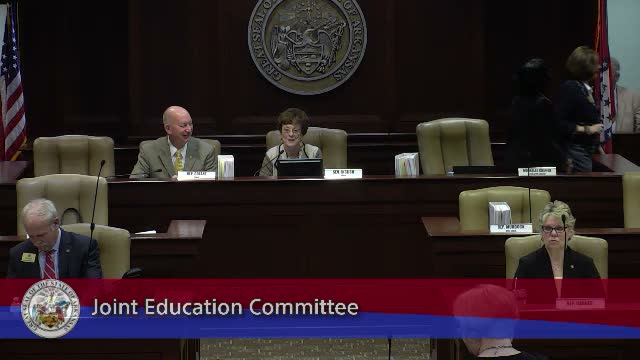
Legislative analyst explains Arkansas' ESA poverty funding, cautions on data distortions from federal meal programs
Summary
A Bureau of Legislative Research presentation to the Senate Education Committee outlined how Enhanced Student Achievement (ESA) funding is distributed, how CEP and Provision 2 participation can distort low-income counts on tests, and flagged expenditure coding and a 2022 sunset that could leave ESA uses undefined.
Nell Smith of the Bureau of Legislative Research told the Senate Education Committee that Arkansas's Enhanced Student Achievement funding (formerly National School Lunch State categorical funding) is distributed to districts based on the number of students eligible for free or reduced-price lunch and the concentration of poverty in each district. "ESA funding provides additional money to school districts to help with the educational challenges that come with high concentrations of students in poverty," Smith said.
Smith traced the program's name change to Act 1083 of 2019 and explained the state uses a three-tier per-student rate structure. In the briefing Smith cited per-student figures as transcribed in the presentation materials (transcript: $526 for the lowest tier, a middle-tier figure transcribed as $1,051, and a highest-tier figure transcribed as $15.76) and warned the "70 percent cliff" between tiers can cause large funding swings when a district's free/reduced lunch percentage crosses the threshold.
She described two federal meal-program options that affect ESA calculations: Provision 2 and the Community Eligibility Provision (CEP). "In participating districts, every student is considered a free lunch student," Smith said, and she warned states and analysts must be careful when comparing low-income student achievement across districts that adopted CEP to those that did not. Smith showed a comparison in which the share of ACT Aspire test takers identified as low-income rose from about 75% to 94% in districts after CEP adoption, a change she said likely reflects reclassification rather than a sudden rise in students' economic need.
Smith also summarized three additional ESA components: a three-year transitional adjustment to phase in changes between funding tiers, ESA growth funding for districts whose total enrollment grows by at least 1% annually over three years, and ESA matching grants created in 2017-18 to encourage spending on pre-K, before- and after-school programs, and tutoring. She reported that districts collectively received roughly $230,000,000 in ESA-related funding in 2019 when those components are combined.
On how districts spend ESA dollars, Smith said reporting in APSCN (the state's financial reporting system) uses program codes that do not always align with statutory allowable uses. That mismatch makes it hard to see how funds are spent at a glance. Using auxiliary coding work, Smith said roughly $40 million of expenditures were coded as "other DESE-approved activities" in 2019 and that about 15% of that "other" category represented school resource officers and other security needs.
Committee members pressed Smith on implications of a statutory sunset in 2022 for the list of allowable ESA uses. Representative Lowery asked whether expiration of the list would render ESA funds unrestricted; Smith replied, "I'm not an attorney, but I will say that if there's no list of allowable uses, there is nothing dictating that it be spent in a particular way," and said the General Assembly could act before the sunset. Members also asked whether ESA spending patterns correlate with improved outcomes; Smith said her analysis found no statistically significant correlation between the mix of allowable uses and student-growth measures, and cautioned that concentration of poverty appears to be a major driver of outcomes.
The committee discussed next steps, with several members urging a systemic review of how the state defines the purpose of ESA funding and how districts report expenditures. The committee moved on to public and organizational testimony after the presentation.