Get Full Government Meeting Transcripts, Videos, & Alerts Forever!
Get email alerts on the Vendor Apa Wested topic
No spam. Unsubscribe anytime.
APA and WestEd present statewide plan that emphasizes educator panels, case studies and fiscal modeling
Summary
Augenblick, Polich & Associates and WestEd proposed an approach centered on extensive stakeholder engagement—eight listening sessions, 16 educator panels, 12–16 case studies—plus multivariate regression, GIS mapping and fiscal models to inform Arkansas' adequacy review.
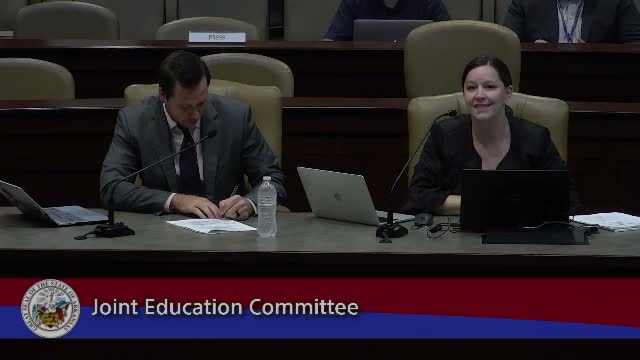
Amanda Brown of Augenblick, Polich & Associates and Jason Willis of WestEd told the joint Education Committee they propose a statewide study with deep stakeholder engagement and a heavy quantitative core. "APA will be the primary vendor for this study," Brown said, stressing APA’s national experience developing state finance formulas; Willis emphasized WestEd’s analytic strength and planned fiscal and performance modeling.
The APA/WestEd bid centers on three stakeholder strands: open listening sessions across four locations (eight events total), 16 targeted educator panels that would engage roughly 320 educators in multi‑hour sessions, and broad online surveying that the presenters said can capture input from thousands of educators, parents and community members. The team also proposed 12–16 case studies of schools identified through performance analysis, district surveys to fill data gaps (capital needs, program availability, size policies), and GIS visualizations to show program and service gaps across the state.
On methodology, the team said it would run time‑series and multivariate regression analyses to isolate growth and the relationship between spending and outcomes and would model fiscal impacts of specific policy changes (for example, voucher participation, uniform tax rates and enrollment shifts). Jason Willis noted the revised RFP removed some earlier cost‑estimation approaches; APA/WestEd said they would not produce a single aggregate dollar figure but would include fiscal modeling for targeted components and identify resource gaps in the state’s allocation matrix.
Committee members asked whether the team would consider Lakeview and international benchmarks, whether educator panels would be open or closed, and whether APA/WestEd would estimate costs. The presenters said listening sessions would be public and open to media; targeted educator panels would be limited to encourage candid practitioner feedback. On costs, they said remaining fiscal work in the RFP allows for modeling of component costs but the RFP removed the professional‑judgment and successful‑schools approaches that would have produced an aggregate cost of adequacy.
APA/WestEd also described ongoing projects (including a multi‑phase study in Utah) to illustrate capacity for a long, multi‑strand engagement. The presenters committed to monthly updates and shorter white papers as interim deliverables to keep the committee informed throughout the study.
The presentation concluded and the committee moved into deliberations on whether to hire an outside consultant or continue review work in‑house.