Get Full Government Meeting Transcripts, Videos, & Alerts Forever!
Get email alerts on the Special Education Funding topic
No spam. Unsubscribe anytime.
Committee advances rule revising Special Education High Cost reimbursement formula after extended debate on winners and losers
Summary
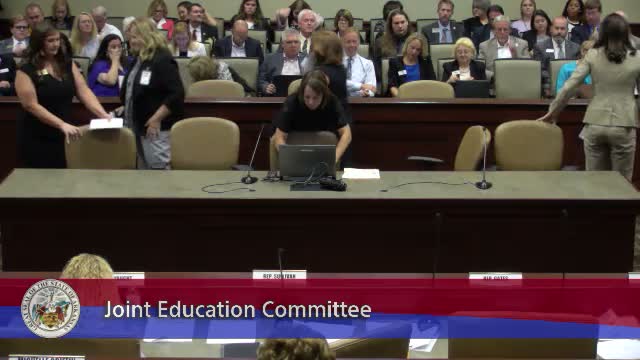
The Senate Education Committee reviewed proposed changes to the Special Education High Cost (formerly Catastrophic Occurrence) Fund rule that would stop reimbursing the first $15,000 of eligible student costs and reallocate a larger share to the highest‑cost students; the committee voted to recommend the rule for approval and asked the department for district‑level maps and lists.
The Senate Education Committee spent more than an hour questioning the Department of Education about proposed rules to revise how the state reimburses local districts for extraordinarily expensive special education cases.
Courtney Salas Ford, deputy general counsel for the Division of Elementary and Secondary Education, reviewed the fund’s history and finances: the program originated after a 2003 recommendation and a 2004 law creating a high‑cost reimbursement pool; initial funding was $1,000,000, later increased in steps to $13,000,000 in recent years. Salas Ford said the number of claims has risen faster than funding, producing a drop in the pro rata share districts receive—78% in FY2013 versus roughly 38–41% most recently—so the division convened stakeholders to examine more equitable distribution methods.
Under the existing rule, once a district’s expenditures for an individual student reached a $15,000 threshold the district received reimbursement for that amount (100% for the first $15,000, 80% for the next tier, 50% above that up to a cap). The proposed rule would stop reimbursing the initial $15,000; instead the department would reimburse 100% of eligible costs above $30,000 up to $65,000, and 80% above $65,000. Salas Ford said the change is intended to target limited state dollars at students with the most extraordinary costs and to reduce incentives for districts to treat common classroom costs as catastrophic claims.
The presentation included fiscal examples and historical claim counts: in one review of FY2018 claims the division saw $31,000,000 in approvable claims against a $13,000,000 fund, producing a roughly 41.5% proration. The department shared that on 12/01/2017 the state had about 59,919 students receiving special education, of whom 1,300 generated catastrophic/high‑cost claims from 164 districts; 183 claims were between $15,000 and $17,000 while 18 claims exceeded $155,000.
Legislators pressed on who would gain or lose. Some members objected that the new structure would shift funds away from certain districts (Representative Dela Rosa said his two districts would lose substantial support), while department staff said projections show about 74 districts would receive more funding and 90 would receive less under the FY2017/2018 baseline. Committee members asked for a map and district lists showing winners, losers and nonparticipants; staff promised to produce the list and said they could turn it into a map.
Lawmakers also raised implementation concerns: many districts do not submit claims because the application is burdensome, and department staff said internal changes to streamline the process are planned. Members asked about the $15,000 threshold: staff said that figure exists in rule (since 2004) rather than statute and that stakeholders reviewed other thresholds but settled on preserving 15,000 as the threshold while removing reimbursement for that initial tranche.
After extended questioning the committee took a voice vote on a motion to recommend the rule for approval; the chair announced the ayes have it. Committee members also voted to approve several informational ISPs and adjourned. Department staff were asked to provide district‑level lists, a map of affected districts, and other data to help legislators evaluate the change before final promulgation.