Get Full Government Meeting Transcripts, Videos, & Alerts Forever!
Get email alerts on the Essa Accountability topic
No spam. Unsubscribe anytime.
ADE presents ESSA school index and MySchoolInfo reporting tools to committee
Summary
Arkansas Department of Education officials reviewed the state's ESSA plan, explained the multi-measure school index (achievement, growth, graduation, school quality/student success) and demonstrated the MySchoolInfo public report-card pages that will display ESSA index scores and supporting data.
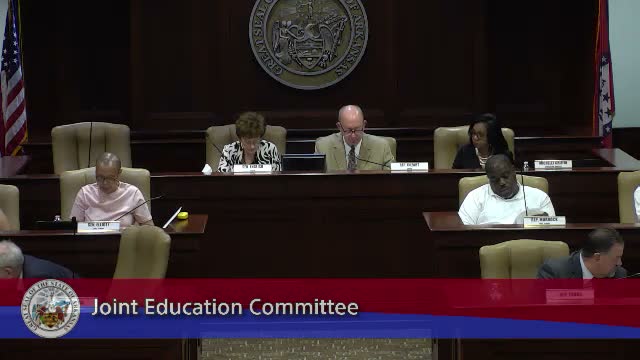
Deborah Kaufman, Public School Accountability director at the Arkansas Department of Education, and Dr. Eric Flowers presented the state's Every Student Succeeds Act (ESSA) accountability plan and the MySchoolInfo public reporting site.
Kaufman said the ESSA plan was developed through broad stakeholder engagement and has been approved by the U.S. Department of Education. "Our vision at the Department of Ed is to transform Arkansas to lead the nation in student focused education," she said. The ADE presentation emphasized that the state uses multiple measures rather than a single test score: weighted achievement, student growth, English proficiency progress, graduation rates (4- and 5-year) and a new school quality and student success indicator that includes reading on grade level, science achievement/growth, ACT performance and community service learning.
ADE demonstrated MySchoolInfo (my school info.arkansas.gov), which provides interactive school/district pages, downloadable report cards and a visible ESSA school index with percentile comparisons. Kaufman and Flowers said growth comprises 50% of the elementary/middle index and 35% of the high-school index; stakeholders prioritized growth weighting during plan development. The presenters also noted targeted support provisions under federal rules: the lowest 5% of Title I schools are identified for "comprehensive support," and persistently underperforming subgroups (for example, students with disabilities) can be identified for targeted interventions and monitoring.
The presentation included examples of schools that improved their index scores and described supports—professional learning communities, curriculum alignment, use of interim assessments—that contributed to gains. Kaufman and Flowers invited members to review the October ESSA school index release and to use MySchoolInfo to view school-level data and downloadable reports.