Get Full Government Meeting Transcripts, Videos, & Alerts Forever!
Get email alerts on the Education Stem topic
No spam. Unsubscribe anytime.
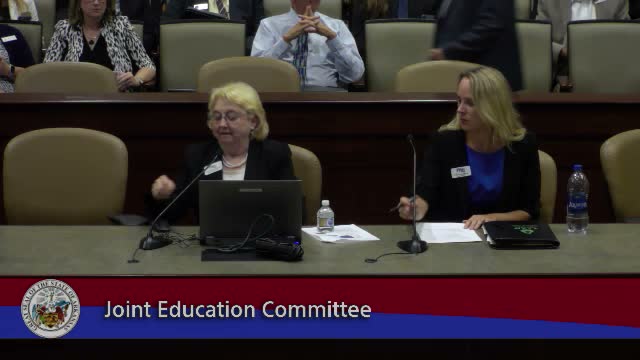
Arkansas STEM Coalition, DOE update committee on statewide STEM pipeline, Math Quest and hands-on learning
Summary
The Arkansas STEM Coalition and Division of Elementary and Secondary Education briefed the Senate Education Committee on programs to expand hands‑on STEM learning, professional development for teachers (AR Math Quest), regional STEM centers and a planned public database mapping statewide STEM offerings.
Suzanne Mitchell, director of the Arkansas STEM Coalition, told the Senate Education Committee the coalition’s mission is to strengthen the K–20 STEM pipeline through partnerships among business, education, government and community leaders. She described a history of federal and private grants that helped build 12 STEM centers on university campuses and a portfolio of programs aimed at increasing participation, especially among underrepresented girls and rural students.
Mitchell highlighted the coalition’s hands‑on events — “STEM girls” conferences and middle‑school health career days — and the statewide laptop‑loan program initially funded by AT&T and augmented by local donations. She said the coalition has distributed more than $800,000 in science equipment grants funded by the education license‑plate program to supply schoolrooms with microscopes, weather stations and manipulatives and to provide in‑class teacher support rather than unrestricted cash grants to schools.
Kristin Koenigsfest, the coalition’s development and program officer, described an application to become the Arkansas node of a national STEM learning ecosystem. The planned ecosystem would catalog programs and gaps and build a searchable database — developed with the Clinton School of Public Service — so parents and districts can find local STEM options and avoid duplicating services.
Department of Education staff outlined state programs that complement the coalition’s work. Stacy Smith, assistant commissioner for learning services, summarized graduation requirements under SmartCore and described policies that allow certain career and technical education (CTE) courses to count for math and science credit. Tina Moore and Michelle Snyder detailed AR Math Quest (a two‑year professional development initiative that provides 36 hours of face‑to‑face training and in‑class instructional support) and Grasping Phenomenal Science (a statewide science PD system that has trained thousands of teachers).
Presenters described work to expand industry‑recognized credentials and Perkins V alignment for programs of study, examples of student outcomes (drone Part 107 licensure cohorts and robotics competitions) and pilot partnerships with higher education and business for internships and “venture academy” concepts. Committee members pressed presenters on persistent low proficiency in statewide math and science assessments, broadband gaps in rural communities, teacher recruitment and how the state will measure progress. DOE staff said AR Math Quest is designed for sustained classroom coaching and that measurable gains may take multiple years to appear at scale.
Committee members asked for implementation details and requested lists of schools participating in Math Quest and maps showing program coverage. Mitchell and DOE staff committed to follow up with participation lists and further cost or outcome data for the committee’s review.