Get Full Government Meeting Transcripts, Videos, & Alerts Forever!
Get email alerts on the Adequacy Study topic
No spam. Unsubscribe anytime.
BLR outlines 18-month adequacy study, says committee defines "adequacy"
Summary
Bureau of Legislative Research staff told the Senate Education Committee that the adequacy study is an 18-month, statute-driven process and that the committee—not staff—makes the judgment about what constitutes adequate K-12 funding; staff will supply evidence, data and policy options but not recommendations.
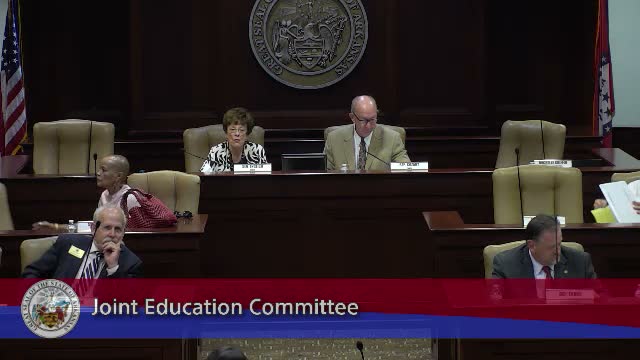
Nell Smith, administrator for the Policy Analysis and Research Section of the Bureau of Legislative Research, told the Senate Education Committee that the adequacy study required by state law is an 18-month process designed to give committee members the evidence they need to decide what constitutes an adequate K-12 education. "Adequacy is what you say it is as long as it's grounded in evidence," Smith said.
Smith reviewed the statutory history that guides the study, including Act 57 of the 2003 extraordinary session and later amendments, and explained how BLR will support the committee. She said foundation funding and state/local shares together provide about $3,000,000,000 to schools and that roughly 41% of state tax dollars go to K-12 education. Smith described BLR's analytic tools: district-reported data (AppScan), surveys of superintendents/principals/teachers, and a representative sample of about 74 school site visits for in-person interviews and observations.
Smith emphasized two constraints committees must respect: funding recommendations must be based on evidence and on assessed district needs rather than simply fitting available dollars. She also described deliverables and timing: BLR will provide monthly topical reports to inform the committee's November final recommendations (statutory submission deadline noted as November 1, 2020). "We will provide policy options, but we do not provide recommendations," she said, explaining staff will avoid characterizing programs as adequate or inadequate so that the committee retains responsibility for judgments.
Committee members pressed staff on who will be surveyed and what data will be used. Senator Chesterfield asked specifically whether support professionals (aides, bus drivers, maintenance) would be surveyed; Smith said BLR had focused first on superintendents and teachers but can add other staff where contact information allows. Representatives and senators also questioned data reliability for school-level spending reporting under ESSA and whether the committee can use existing school-level coding; staff said reporting consistency varies across districts and that results should be interpreted cautiously.
Smith described options the committee can recommend—changing funding levels, altering what the matrix funds, loosening or tightening spending restrictions, or moving programs to categorical funding at the state level—and noted that statutory language determines minimum study requirements while the committee decides additional scope. She also explained that, depending on the committee's direction, BLR can add targeted analyses (for example, class-size scenarios or transportation funding models).
The presentation closed with an outline of meetings, public comment mechanisms (including a soon-to-be-posted website link), and the process for producing a draft adequacy report for members to review before the committee fills in its final recommendations.