Get Full Government Meeting Transcripts, Videos, & Alerts Forever!
Get email alerts on the Lakeview And Legal Framework topic
No spam. Unsubscribe anytime.
Lakeview rulings frame Arkansas legislature’s adequacy work, BLR attorney tells Education Committee
Summary
A Bureau of Legislative Research attorney told the Senate Education Committee the Lakeview school‑funding litigation and Arkansas Constitution Article 14 require an ongoing, evidence‑based adequacy study; the legislature — not the court — defines adequacy and can change the funding matrix.
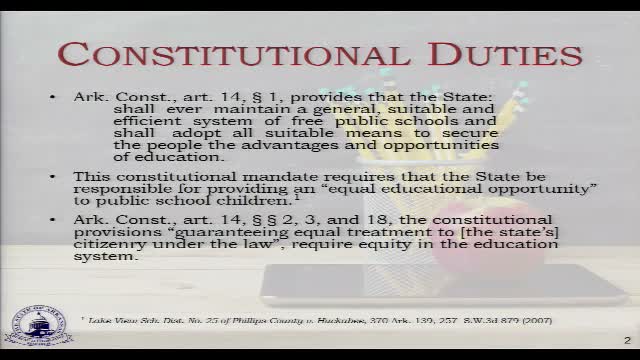
Taylor Lloyd, staff attorney for the Bureau of Legislative Research, told the Senate Education Committee that the Lakeview case and Article 14 of the Arkansas Constitution create the legal baseline for the state’s adequacy study and the legislature’s duties.
Lloyd summarized Lakeview’s multi‑decade history, saying the chancery court and later the Arkansas Supreme Court repeatedly found constitutional deficiencies in the state’s school‑funding system in the 1990s and early 2000s and imposed a series of mandates. “Without the study you’re flying blind,” she quoted the court, adding the court has required an ongoing, evidence‑based adequacy evaluation and continual oversight of how revenues are spent.
The presentation outlined three legal takeaways: the legislature must define adequacy (the court cannot do so for the General Assembly); the state must assess and monitor public education funding; and the adequacy review is a continuing duty that must inform biennial funding decisions. Lloyd noted statutory responses that followed Lakeview, including the continuing adequacy evaluation act (2004), categorical funding, foundation funding and minimum teacher‑salary provisions.
Committee members pressed Lloyd on the difference between a funding matrix and a spending formula. Lloyd repeatedly said the boundaries are for the legislature to set: the General Assembly “alone” can decide whether the matrix remains a funding tool or becomes a spending formula, but she cautioned she could not predict how courts would react to particular legislative changes.
The committee did not take formal action on Lloyd’s legal overview. She recommended members treat adequacy as a fluid, biennial process that can be amended by the legislature based on evidence presented during the adequacy study.
The committee recessed after the Q&A and proceeded later to a separate presentation on funding mechanics.