Get Full Government Meeting Transcripts, Videos, & Alerts Forever!
Get email alerts on the School Facilities Wealth Index topic
No spam. Unsubscribe anytime.
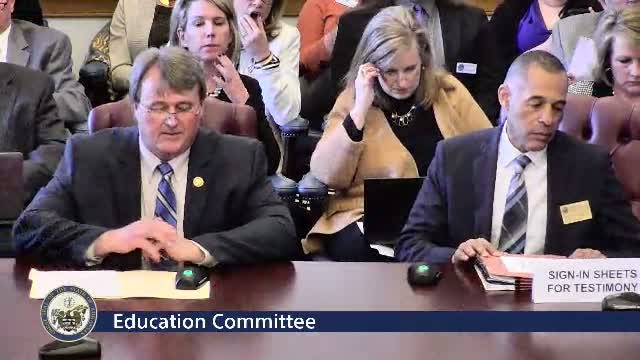
Committee advances proposed rewrite of school facilities 'wealth index' after heated testimony
Summary
A proposed change to the academic facilities wealth index (adding decade-high ADM and family median income) would reallocate partnership dollars: division analysis found 74 districts gain state share while 51 lose it; public testimony from Bryant and Bentonville warned of negative effects on growing districts but the committee moved the measure forward.
Division staff and the advisory committee described a proposed revision to the Academic Facilities Partnership formula intended to reallocate state facility dollars more equitably.
Division staff summarized historical distribution of partnership funds and presented impact analysis showing that funds have concentrated among a small number of districts: "Statewide, of that $1,200,000,000, 5 districts have received about 17% of that overall funding or about $219,000,000," staff told senators. The advisory group recommended adding the highest average daily membership over a decade and family median income measures to the wealth index calculation to better account for growth and poverty.
Greg Johnson and division staff provided county‑by‑district impact projections: 74 districts would see increases in state share, 10 would be unchanged, and 51 districts would lose state share (29 less than 5%; 22 greater than 5%). Committee members and witnesses questioned both the math and equity tradeoffs.
Karen Walters, superintendent of Bryant School District, said her district would lose 17% under the new formula and warned that growing districts already face construction pressure: "There are 15 districts that are going to lose more than 10%...we're losing 17% under this bill," she told the committee, urging a different approach or amendments. Debbie Jones, Bentonville's superintendent, said Bentonville will be required to build 10 school buildings in 11 years and urged compromise to avoid forcing very high millages on fast‑growing communities.
Rural educators and advocates urged attention to low‑income districts that have historically received little or no partnership funding. Division staff noted separate funding 'pots' for space projects and warm/safe/dry projects moving forward and said a $90 million per year recommendation undergirds longer‑term program viability.
After extended questioning, public testimony and distribution analysis, the committee approved advancing the proposed changes to the wealth index for further consideration.
Next steps include technical adjustments to the formula and additional impact analysis for districts; stakeholders suggested continued negotiation to limit steep losses for specific communities.