Get Full Government Meeting Transcripts, Videos, & Alerts Forever!
Get email alerts on the Higher Education Funding topic
No spam. Unsubscribe anytime.
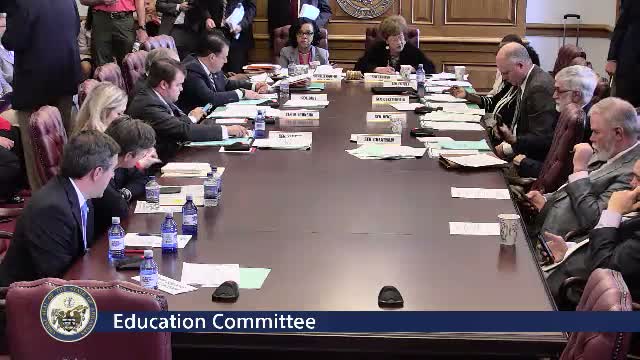
Senator Davis’ plan to reallocate EETF funding ignites weeks‑long debate in Education Committee
Summary
Senator Bridal Davis proposed shifting portions of the Educational Excellence Trust Fund toward in‑state FTE allocations while holding institutions harmless until their FTE share surpasses current funding; higher‑education leaders warned the change would disadvantage research missions and specialized programs, prompting extended testimony and requests for more analysis.
Senator Bridal Davis introduced legislation to reallocate parts of the Educational Excellence Trust Fund (EETF) so a specified programmatic portion would be distributed based on in‑state full‑time equivalent (FTE) student counts rather than fixed line items. Davis said the change would direct more of the state’s EETF dollars to institutions educating large numbers of Arkansas students and would be implemented with a hold‑harmless provision so no institution would immediately lose funding.
Davis framed the measure as an equity correction. “We are giving three‑quarters of a billion dollars to higher education every year with almost no accountability tied to a metric,” she told the committee, arguing that the current allocations leave some institutions chronically underfunded relative to the number of Arkansas students they serve.
University leaders and higher‑education advocates pressed the committee for a careful review. Glenn Jones, president of Henderson State University and chair of the performance‑funding work group, said the model the work group recommended is outcomes‑focused and intentionally accounts for institutional differences. “When you hear ‘my institution, my institution,’ you’re hearing about the institution, but you’re not hearing about the student,” he said, arguing that shifting EETF money to a raw FTE formula would move the state back toward an enrollment‑driven model rather than rewarding completion or workforce alignment.
University of Arkansas at Pine Bluff Chancellor Lawrence Alexander and other presidents warned that research expenditures and the unique missions of some campuses are not captured by a simple FTE metric. Maria Markham, director of the Department of Higher Education, told senators the agency had only recently received the amendment and that, in some implementation scenarios, several institutions could see allocation changes in the first year of the bill’s effect. ADHE officials noted that the amendment’s choice of a fiscal year as the hold‑harmless baseline means implementation timing would produce winners and losers in the initial allocation.
Committee members pressed Davis on safeguards. Several senators said they supported revisiting EETF allocations but urged a transparent, phased approach that models second‑order effects (for instance, the consequences for institutions’ bond covenants, research funding and program costs) before enacting a permanent change. Davis said she was willing to continue negotiations with higher‑education leaders and described the current bill as a first step toward a more accountable distribution mechanism.
The committee did not take a final floor vote on the proposal that day; senators asked ADHE for more precise fiscal models and for follow‑up discussions to address concerns raised by campus leaders. Next procedural steps were left open pending that additional analysis.