Get email alerts on the School Drug Screening topic
No spam. Unsubscribe anytime.
Senate panel advances permissive measure allowing districts to implement school employee drug screening
Summary
House Bill 1396 would permit local school boards to adopt employee drug‑screening programs; committee testimony highlighted concerns about who pays for tests, Fourth Amendment implications, and operational details for avoiding student exposure to testing.
House Bill 1396 (authored in the transcript by Representative Mary Bentley) would authorize local school districts to implement employee drug‑screening programs if the district chooses to do so.
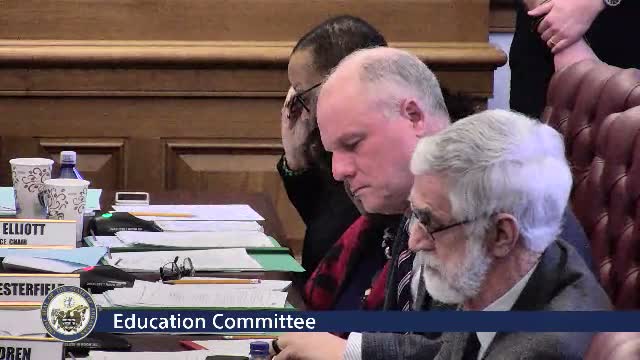
Chair Jane English introduced the bill and committee members asked detailed operational and constitutional questions. Senator Chesterfield asked who would pay for tests; witnesses from the Arkansas School Board Association and the Arkansas Association of Educational Administrators said the entity requiring a test typically pays and practice varies by district. Tony Prothrow of the Arkansas School Board Association said districts "traditionally" pay for employee drug testing and noted bus drivers are already tested intermittently for safety reasons.
Richard Abernathy of the Arkansas Association of Educational Administrators said his group supports permissive language allowing districts that want testing to adopt it, while acknowledging concerns about professional dignity and the message to students. Committee members discussed whether the bill would deter teacher recruitment, whether tests could be required for current employees as well as applicants, and whether testing would be conducted in private settings to avoid student exposure.
The committee voted to give the bill meeting consideration and later took a do‑pass motion; the transcript records voice votes (ayes and noes) but does not provide a roll‑call tally or named vote record in the provided segments.
AI generated
The text on this page is AI generated. Summaries, highlights, analysis, and video transcripts are all produced from the original source material.
AI can make mistakes, so if you spot one, and we will fix it for everyone.
Note: the source content is unaltered by us. Any content source we link to, be it a video, an audio recording, or a document, is presented exactly as its publisher released it. That publisher is usually a government body, sometimes an individual official or another organisation.