Get Full Government Meeting Transcripts, Videos, & Alerts Forever!
Get email alerts on the Education Health topic
No spam. Unsubscribe anytime.
Health curriculum bill advances after hours of testimony over scope, opt-outs and who sets materials
Summary
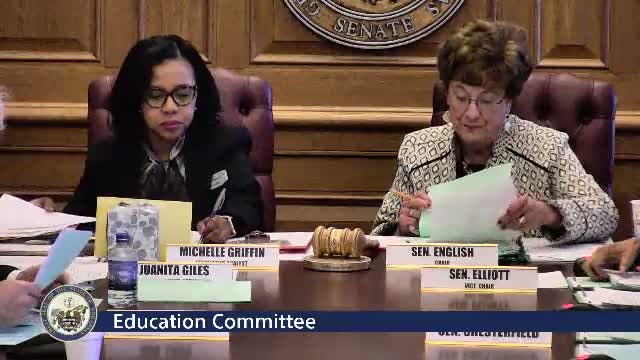
The Healthy Arkansas Education Act, which lists topics for health classes and directs agencies to identify evidence-based resources, moved out of the Senate Education Committee after extensive debate over parental opt-outs, UAMS involvement and whether existing standards already cover the subjects.
Senator Bond introduced the Healthy Arkansas Education Act (SB 304), saying the bill aims to ensure core health topics are addressed for Arkansas students in the wake of high rates of teen pregnancy, suicide and other youth risk behaviors. “We lead the nation in teen pregnancy,” Bond said while describing county-level birth-rate statistics he circulated for senators.
Bond and Department of Education staff stressed the bill is intended to add clarity, not to micromanage classroom curriculum. Stacy Smith of the Department of Education told the committee that the new health standards are being considered by the State Board of Education and that “the big topics that he outlined… are currently in the new standards.” She said the department amended the measure to identify resources rather than mandate a single statewide curriculum.
Public witnesses spoke for and against the bill. Several presenters, including Leanne Rosenbaum (director of an Empowered Risk Avoidance Education program) and Elizabeth Bryant (Reality Check Incorporated), said effective, evidence-based curricula already exist in many districts and warned against an open-ended mandate that could replace locally chosen materials. Raymona Ellison of Little Rock Life Skills urged a strong primary-prevention message for the most at-risk students: “These students deserve a very clear primary prevention message with high expectations and one that moves them away from risk,” she said.
Opponents raised specific drafting concerns. One recurring objection was language that would have had the Department of Education, Department of Health and the University of Arkansas for Medical Sciences identify and develop required resources; witnesses argued that without limits that phrasing risks imposing a single, statewide curriculum with insufficient time for review and local input.
Supporters said the bill preserves local control: newly amended language focuses on identifying evidence-based resources and leaves instructional choices to districts; it also explicitly preserves parental opt-out for topics that parents decline. After the testimony and back-and-forth with senators, the committee approved the bill by voice vote.
What happens next: The bill will move to the full Senate calendar; committee members said they may continue to refine the bill’s language on consultation, timelines and the role of UAMS.