Get Full Government Meeting Transcripts, Videos, & Alerts Forever!
Get email alerts on the Committee Roundup topic
No spam. Unsubscribe anytime.
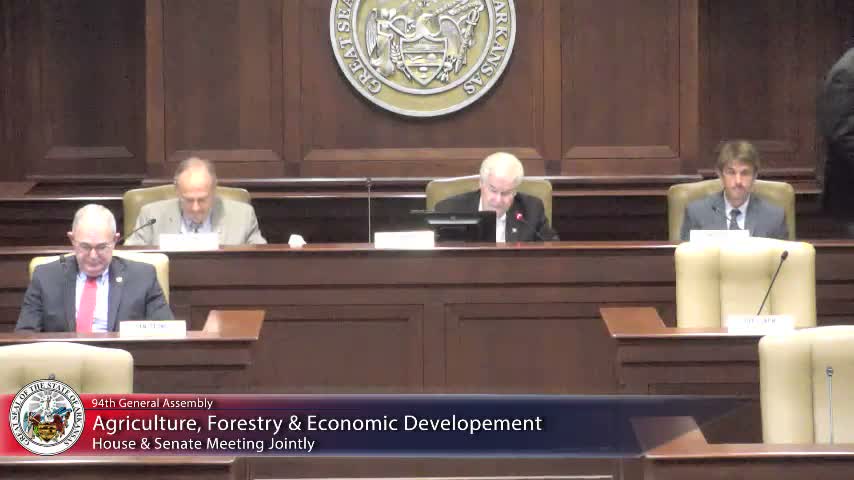
Senate Agriculture committee hears interim studies on fire-district boundaries, food access, raw milk and livestock traceability; adopts study package
Summary
The Senate Agriculture, Forestry & Economic Development Committee reviewed interim studies on fire protection district boundaries, oil-and-gas cost allocation, the Healthy Food Retail Act (HB1645), a raw-milk sales proposal, USDA livestock ID rules, and disaster-recovery tax guidance; the committee voted to adopt the collection of interim studies for further work.
The Arkansas Senate Agriculture, Forestry & Economic Development Committee on Tuesday heard a series of interim studies that could be drafted into legislation next session and voted to adopt the group of studies for follow-up, the committee chair said. Presenters remained available after the meeting to answer members' questions.
Representative Denise Sinnott opened the substantive portion of the meeting with an interim study on fire protection districts, saying boundary changes and municipal growth have left populated "no-man's land" pockets without a clear provider. "This study ... would give the Department of Agriculture the ability to redraw the districts," Sinnott said, and she introduced a panel including Pulaski County Attorney Adam Fogelman and Arch Street Fire Department representative Chris Madison to describe operational problems. Fogelman outlined three scenarios for boundary adjustments—overlapping districts, populated areas outside both city and district lines, and municipal annexation that severs a district—and said any changes would proceed with Department of Agriculture oversight and county-court involvement. Madison said about "76 residences" in his area fall outside both the city and nearby fire district and described the difficulty of providing services and charging fees when boundaries do not match service areas.
Representative Rick Beck summarized an interim study on oil-and-gas production and the allocation of production costs, saying recent court actions (including a 2024 Arkansas Supreme Court development he referenced) affect how net production costs are defined for integrated wells. Beck said stakeholders will be consulted and a bill drafted to incorporate court guidance into statute.
Representative Tibby McCullough presented HB1645, the Healthy Food Retail Act, as a mechanism to address food deserts across Arkansas. The bill would create a program—housed in the Arkansas Economic Development Commission or administered by a nonprofit/CDFI—that could provide grants and loans for projects ranging from traditional grocery stores to mobile markets, delivery hubs and farmers markets. McCullough cited a December 2022 working-group report and emphasized partnerships with organizations such as the Arkansas Hunger Relief Alliance and Cooperative Extension for nutrition education. Vice Mayor Cathy Webb said Little Rock has budgeted $1 million this year for a mobile grocery store pilot and invited committee members to its opening once bids are awarded.
Representative Cameron Cooper described an interim study to amend Arkansas' raw-milk law (he cited Act 1209 of 2013 and a code citation given in the transcript) to remove the requirement that raw-milk sales occur only on the farm. Cooper said the change would allow producers to sell at farmers markets or arrange deliveries while retaining the required product labeling that warns consumers they assume liability for consuming unpasteurized milk.
Patrick Fisk of the Arkansas Department of Agriculture briefed the committee on USDA action affecting livestock identification, describing changes to 9 C.F.R. part 86 (disease traceability for livestock moving interstate). Fisk said the federal rule finalized in April 2024 with a November 5 implementation date and that the Department has been providing free electronic identification (EID/RFID) tags, readers and voluntary calfhood vaccinations that include tag installation. He noted the department's survey found old metal tags fail at roughly a one-in-six rate, which undermines traceability.
Michelle Buffkin Horton, executive vice president of the Arkansas Cattlemen's Association, urged lawmakers to inform producers about disaster-recovery assistance and tax treatment. Horton said producers sometimes decline USDA disaster funds because of perceived tax consequences, and she said state provisions enacted in 2015 may make such assistance tax-exempt; she said her organization is working with the governor's office to confirm coverage and asked legislators to help share the information.
Procedure and vote: early in the session the committee approved minutes by voice vote, and later a motion to adopt the interim studies package was seconded and approved by voice vote; the chair stated the motion passed. Several presenters told the chair they would remain after the hearing to take questions from members and interested parties.
What happens next: committee members said they expect staff to draft bills or working-group follow-ups where warranted, coordinate with stakeholders and return draft proposals or specific bills during the legislative session if the interim work identifies viable statutory changes.