Get Full Government Meeting Transcripts, Videos, & Alerts Forever!
Get email alerts on the Teacher Pay topic
No spam. Unsubscribe anytime.
Committee advances teacher salary enhancement bill with $60 million four‑year bridge
Summary
The Senate Education Committee advanced House Bill 1145 to phase in higher minimum teacher pay toward $36,000 using a one‑time $60 million bridge; lawmakers pressed officials on long‑term adequacy, small‑district impacts and step increases.
LITTLE ROCK — The Senate Education Committee on the record advanced House Bill 1145, a plan sponsors said will phase in a higher minimum teacher salary and add a $60 million, four‑year bridging fund to move starting pay toward $36,000.
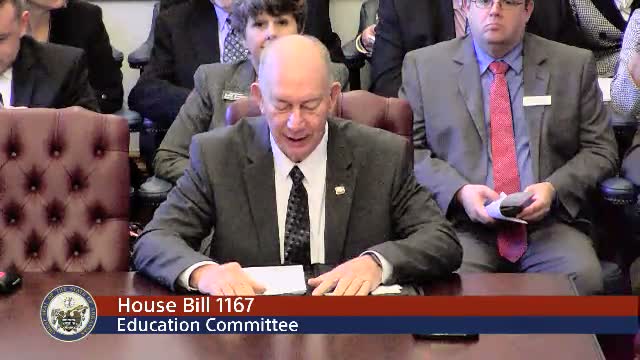
Representative Bruce Cozart, sponsor of the measure, told the committee, “This is the act to create a teacher salary enhancement act,” and said the $60,000,000 “is funded for the the next 4 years.” He said the funding will come from the state's adequacy fund and that details about implementation will be worked out in rules and regulations.
Department of Education Commissioner Johnny Key said the proposal has three parts: the one‑time $60 million bridge, an ongoing adequacy commitment from the general assembly, and local district decisions about staffing and step structures. Key said the department’s analysis incorporated current district salary schedules and trends and that the $60 million estimate was conservative to provide a cushion.
Committee members pressed for specifics about the plan's longer‑term effects and on districts with small enrollments or limited tax bases. Senator Chesterfield asked whether the $60 million was a one‑time appropriation; Cozart replied, “Yes,” and said the adequacy process would be resumed immediately after session to address sustainability.
Several senators asked how step increases and local pay schedules would interact with the state minimum. Commissioner Key said the department accounted for existing step structures in its calculations and noted that local decisions beyond the minimum remain the responsibility of districts.
Representatives of education groups and rural districts told the committee that while the funding is welcome, some small districts could still face a funding gap after the bridge period. Mike Mertens of AAA and Dale Query of the Arkansas Rural Education Association both urged continued study and close collaboration on implementation.
The committee’s action advances the bill for further consideration; sponsors said they plan an adequacy study and additional rule work in the months after session to answer outstanding questions about long‑term funding and district impacts.