Get Full Government Meeting Transcripts, Videos, & Alerts Forever!
Get email alerts on the Career Technical Education topic
No spam. Unsubscribe anytime.
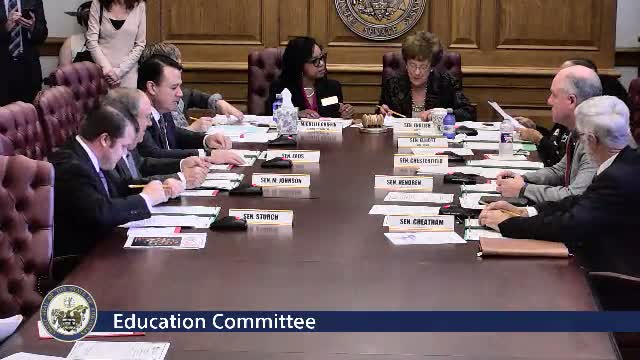
Senate panel advances bill to replace flat vocational-center funding with tiered model
Summary
The Senate Education Committee advanced Senate Bill 135 to replace a $3,250-per-FTE flat payment with a tiered funding structure for secondary vocational centers; agency officials said the plan would better match program costs to employer needs while superintendents and center directors urged more regional input and fiscal analysis.
Charice Childers, director of the Arkansas Department of Career Education, told the Senate Education Committee that Senate Bill 135 would discontinue the current flat $3,250 per full-time equivalent payment and create a tiered funding structure to better align funding with program costs and labor-market demand. "Senate bill 135 allows for our current funding structure of $3,250 per full time equivalent to be discontinued in favor of establishing a tiered funding structure for distributing vocational center aid," Childers said during her presentation.
Childers said the department has budgeted $20,100,000 for vocational center aid, on top of standard foundation funding, and that the proposed tiers would be vetted for roughly 9 to 12 months and reviewed annually. The agency also explained the change would allow real-time payments once enrollment is reported rather than the current multi-source, multi-year arrear system.
Industry witnesses said workforce partnerships depend on stable funding for equipment and instructors. Brian Richardson, speaking for the Northeast Arkansas Career and Tech Center and regional employers, urged caution: "Please do not do anything to cause these centers to lose money" and warned that centers already struggle to buy up-to-date equipment and hire qualified instructors.
Agency staff responded that the bill emphasizes programs sought by employers — manufacturing, trades, STEM, health care and IT — and that it would increase funding for many of those programs. "Funding under this bill would increase by over $2,500 per FTE," Cody Waites, deputy director of the Department of Career Education, told the committee.
Several superintendents and college leaders urged more regional analysis and better data systems before implementation. Mike Poor, superintendent of Little Rock Public Schools, said outreach and fiscal analysis have lagged and that district-level impacts differ widely across the state. Margaret Ellerbee, chancellor at UA Pulaski Technical College, told senators the state lacks a comprehensive data system tying graduates to employment and wages and urged stronger verification before performance-based funding is used.
Senators also pressed the department about who participated in advisory meetings and whether the advisory group reflected geographic and racial diversity; Childers provided a list of invited participants and said the department would expand outreach.
Sponsor Senator Hammer closed by saying the change would increase transparency and efficiency and the committee advanced the bill by voice vote. The committee did not record a roll-call tally in the hearing transcript; the chair announced that the ayes had it and the bill passed out of committee.
Next steps: the bill will proceed through the Senate floor scheduling process and the department expects additional public meetings and local needs assessments before final tiers are proposed to the Career Education Workforce Development Board.