Get Full Government Meeting Transcripts, Videos, & Alerts Forever!
Get email alerts on the Infrastructure Water topic
No spam. Unsubscribe anytime.
State adviser and engineers discuss sewer link for proposed prison; council approves $5,000 study
Summary
City council heard detailed feasibility analysis on taking prison wastewater and voted to authorize up to $5,000 from the current-year budget for preliminary engineering, with the state offering to reimburse the city for those costs as the parties continue negotiations.
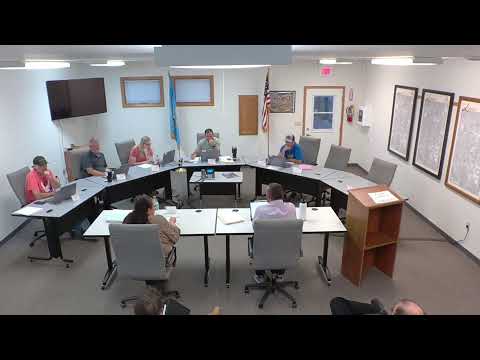
Lennox city officials on Monday heard technical testimony about whether the city’s wastewater treatment plant can accept flows from a planned Department of Corrections (DOC) facility, and the council voted to authorize up to $5,000 for preliminary engineering services to refine cost estimates.
Ryan Bruner, a senior policy adviser to Gov. Knowles, told the council the governor’s office and state engineers are exploring whether the state’s new facility could route wastewater into Lennox’s system. Bruner said the state will reimburse the city for costs to pay Stockwell for that initial work if the council approves invoicing the DOC for the expense: “We’re willing to reimburse what your costs are,” he said, adding the state is in an exploratory phase and seeks partnership from the city.
Consultant John Brown detailed the plant upgrades the city would likely need even without taking DOC flows — basin covers, diffuser replacement, solids dewatering (a dewatering press), pump and electrical upgrades — and explained how adding prison wastewater would change operations. Brown said the plant’s nameplate capacity is about 670,000 gallons per day (gpd) while recent average flows are roughly 180,000–200,000 gpd. He said DOC flows could range from about 80,000 gpd to 220,000 gpd in different scenarios and that, using a cautious example, the city’s average daily flow could rise to roughly 400,000 gpd. That increase, Brown said, would likely require an equalization (EQ) basin up front to smooth peak flows and maintain consistent loading.
Brown cautioned that many capital needs — replacement diffusers, decanters, improved screening and solids handling, electrical work — will be necessary in the next five to 15 years irrespective of DOC business and suggested some costs could be shared with the state if an agreement is reached.
Bruner outlined possible contract structures and funding options based on other negotiations the state has pursued: a take-or-pay contract example paying for 175,000 gpd at $52,500 per month (approximately $10 per 1,000 gallons), a $9,000-per-month connection fee (about $108,000 per year), and an ARPA-eligible capacity-purchase figure the state cited at $7,179,000. He also noted a statutory constraint: a law about sewer service within 10 miles of a community, and that the site under discussion currently sits approximately 10.4 miles away; options include annexation or a legislative exemption.
Council members pressed for technical assurances: whether grinders and screening would be sited at the prison, how pre-treatment and grease/separation would be handled, whether detention ponds were included in design, and how a 10-mile forced main would be protected from infiltration. Bruner and the consultants said much remains preliminary but described on-site pre-treatment, detention and EQ-basin options under review.
After discussion the council voted in favor of a motion authorizing up to $5,000 from the current-year budget for services related to the DOC sewer connection. The motion carried by roll call vote. The council’s approval authorizes Stockwell (the city’s engineer) to proceed with preliminary review; the state offered to reimburse the invoice if the DOC proceeds with a contract.
Next steps described to the council: city and state engineers will refine feasibility analyses over the coming weeks, the city will coordinate with operator Kyle on design details and costs, and both parties will examine statutory and annexation implications before any formal contract is negotiated.