Get Full Government Meeting Transcripts, Videos, & Alerts Forever!
Get email alerts on the Pond Management topic
No spam. Unsubscribe anytime.
Task force hears short-term Warner’s Pond management plan stressing monitoring, stewardship and a five-year trial
Summary
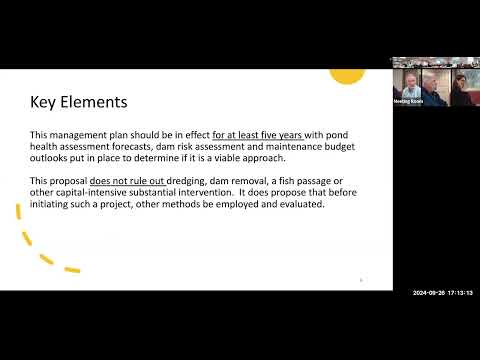
A task force work group presented a proposal to institutionalize monitoring, coordinate stakeholders through a roundtable, and try organized pond-management measures for at least five years before pursuing capital projects such as dredging or dam removal.
Mark Howell, presenting the short-term actions work group’s proposal to the Warner’s Pond Task Force, urged a cautious, organized path forward that prioritizes monitoring and stakeholder coordination.
“Warner’s Pond is cherished by many,” Howell said, framing the proposal’s assumptions and noting competing demands on town resources such as the Bruce Freeman Rail Trail and new Jerome Park facilities. The plan calls for a management roundtable—modeled on Concord’s housing roundtable—led by the Natural Resources Commission to bring town departments and outside stakeholders together to agree responsibilities, collect baseline environmental and recreational data, and oversee experiments in invasive plant control.
Why it matters: The proposal aims to give the town a replicable process for managing water quality and recreation without committing to major capital projects up front. Members emphasized the need to understand the “status-quo” trajectory and to budget staff time and consultant costs explicitly.
Task force members urged clearer definition of what happens if nothing changes and recommended adding cost estimates and staff-time accounting to the proposal. The group discussed techniques used elsewhere—gravity drawdowns, diver-assisted suction harvesting and staged management trials—and cautioned that permitting and engineering review would be required for actions such as drawdowns.
The proposal recommends a five-year period of organized management and monitoring as a first phase; larger interventions (dredging, fish passage or dam removal) would remain on the table if monitoring and feasibility work point to those steps.
Next steps: The work group will refine cost and staffing estimates, clarify permit pathways for drawdown experiments, and report back to the task force for further evaluation and potential referral to a future vote of the Select Board or Natural Resources Commission.