Get Full Government Meeting Transcripts, Videos, & Alerts Forever!
Get email alerts on the Pavement topic
No spam. Unsubscribe anytime.
Clayton council approves hybrid 2026 paving plan, prioritizing El Portal Drive and Eagle Peak Avenue
Summary
The council approved a $2 million 2026 pavement project using a hybrid approach: manually select El Portal Drive and Eagle Peak Avenue and let the StreetSaver tool select remaining streets. City engineer Larry Theiss will return with a public map and design schedule.
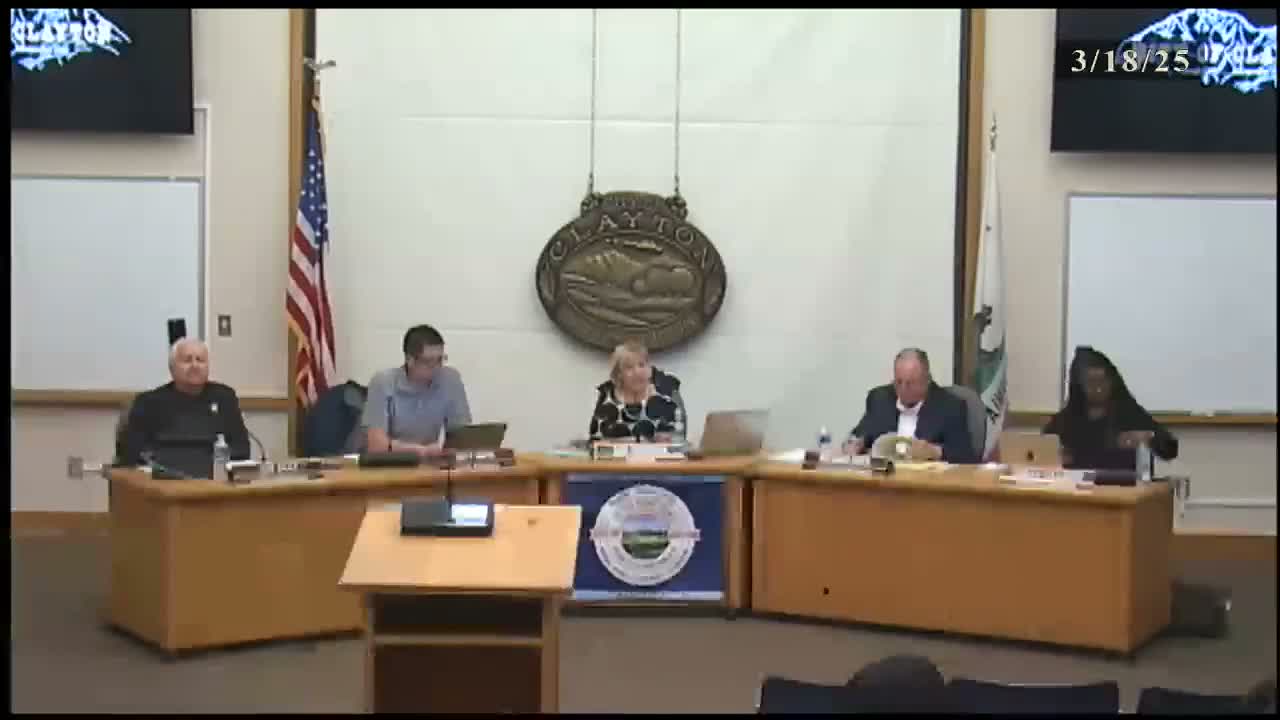
Clayton City Council on March 18 approved a hybrid street‑selection plan for the city's 2026 paving project, directing staff to fund and design a $2 million program that manually includes El Portal Drive and Eagle Peak Avenue while using the StreetSaver optimization tool for remaining work.
City Engineer Larry Theiss told the council that Clayton's pavement condition index (PCI) has declined from 78 to 73 and described tradeoffs in the consultant's scenarios. "The overall network is a 73 out of a hundred," Theiss said, noting that the decline accelerates once streets enter the mid‑range and that earlier, less‑expensive fixes are preferable to delayed full reconstructions.
Theiss described several scenarios produced by the StreetSaver software: an automated selection (Scenario 1A), a 50/50 split that pairs StreetSaver with council‑selected streets (Scenario 1B), a maintenance level to hold the PCI at 73 (an average of about $2.6 million per year), and an aggressive restoration plan to return to a 78 PCI (roughly $23.5 million over five years). He said the planned 2026 project budget of $2 million is consistent with the adopted CIP and current revenue projections, and that available funding for pavement comes primarily from gas‑tax sources including the RMRA and the city's return‑to‑source CCTA allocation.
Council members asked how the tool prioritizes work and whether high‑use collector streets should be treated differently. Theiss said StreetSaver maximizes PCI improvement per dollar but does not account for local priorities such as geographic grouping or business impacts. He identified El Portal Drive as "the worst rated road at, like, a 36," and said Eagle Peak needs a cold‑in‑place recycle rather than a surface treatment, making both costly fixes.
After public comment praising the new assessment and a lengthy council discussion about equity, cost‑effectiveness and geography, the council adopted the hybrid plan (Scenario 1B): allocate budget to include El Portal and Eagle Peak in the 2026 project and let StreetSaver select remaining streets within the $2 million target. The motion passed unanimously.
Theiss said he will publicize the final street list with a map for community review and begin design work so the project can be bid with adequate lead time. The next steps include design, potential grant finalizations (Theiss said a $50,000 TDA grant may contribute to Mount Air Parkway work), and coordination on construction timing to limit business impacts.