Get Full Government Meeting Transcripts, Videos, & Alerts Forever!
Get email alerts on the Public Safety Overview topic
No spam. Unsubscribe anytime.
Shasta County leaders seek measurable public‑safety steps as agencies flag staffing and data gaps
Summary
At a special March 24 meeting, Shasta County officials described staffing shortages, incompatible data systems and court capacity limits and proposed using the Community Correction Partnership to produce crime metrics and short‑term actions to improve safety.
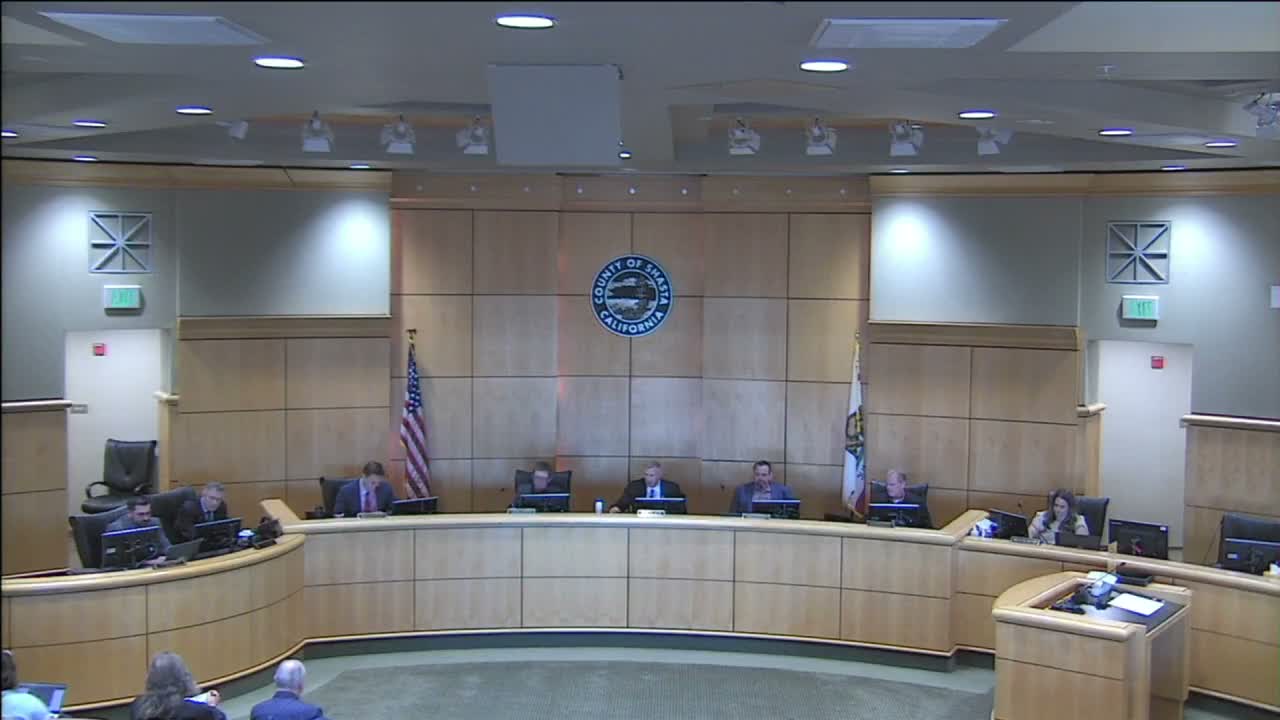
Shasta County supervisors heard a sweeping rundown of public‑safety challenges Monday evening as department heads urged the board to fund staff, fix data systems and coordinate short‑term steps to reduce crime and relieve court backlogs.
Chief Probation Officer Tracy Neal told the board the Community Correction Partnership (CCP), created under Senate Bill 678 in February 2009 and later affected by AB 109 and AB 117, has issued an approved community corrections plan and added a fourth strategy focused on crime prevention and youth services. "We have added a fourth strategy, which is really to include prevention," Neal said, noting the CCP and its executive committee include probation, the sheriff, the district attorney, the public defender, health and human services and a city police chief.
Supervisor Alan Long (referred to in the meeting as Supervisor Long) said he wanted the CCP to be a practical resource for the board. "I would like to have a relationship with CCP and not get into CCP proper but that CCP could help us prioritize public safety in our community," he said, proposing the board task CCP and the juvenile coordinating committee to return within months with measurable recommendations.
County law‑enforcement leaders and the court told supervisors data and technology problems complicate measurement and strategy. Redding Police Chief Barner described the statewide conversion from the Uniform Crime Reporting (UCR) system to the National Incident Based Reporting System (NIBRS) in May 2023 and said local agencies have struggled to extract consistent statistics from the Premier 1 records‑management system. "It’s just not an easy system to work with and for our staff to work with," Barner said.
District Attorney Stephanie Bridgette and public‑defender Ashley Jones urged better interoperability among case‑management systems. Bridgette said the DA’s office is building a public dashboard using Power BI and scripts provided by the San Francisco DA, with an internal target to make more case‑level data available beginning January 2026. Jones said her office needs a case‑management system that can communicate with the DA and law enforcement to reduce manual work and court delays.
Court officials said judicial capacity is a separate bottleneck. Superior Court representative Melissa Fowler Bradley said Shasta has 11 judges and two commissioners (13 bench officers) and is on the SB 75 prioritization list for additional judgeships, which remain authorized but unfunded. She cautioned that assigned or visiting judges are a limited statewide resource and added that converting commissioners to judges does not automatically add bench capacity without additional funding and courtroom space.
Supervisors and department heads also recounted recent grant wins and local programs: Neal said probation secured a Proposition 47 round‑4 grant that will fund a three‑year program (contracts on the board agenda) totaling about $2 million to serve roughly 150–180 individuals annually beginning April 1; Barner and Sheriff Michael Johnson said they have pursued alternative custody and chronic‑offender strategies to reduce repeated low‑level offending.
Public comment underscored the urgency: deputy public defenders and deputy district attorneys described heavy caseloads, low pay and long hours; a victim of alleged domestic abuse said charges in her case were dropped without timely notification; other community members urged investment in prevention, behavioral health and alternatives to incarceration.
The board did not take formal action Monday. Supervisors asked staff to return with options on how CCP, the DA and law‑enforcement partners might produce a short‑term (six‑month) workplan and directed staff to place follow‑up items on a future agenda.