Get Full Government Meeting Transcripts, Videos, & Alerts Forever!
Get email alerts on the Land Use topic
No spam. Unsubscribe anytime.
West Linn council adopts development‑code amendments to clarify appeals, home occupations and land divisions
Summary
The council unanimously adopted Ordinance 1755 (CDC‑24‑02), revising West Linn’s community development code to require appellants to identify appeal grounds, limit extensions of approval, clarify home‑occupation rules and align expedited land‑division procedures with state law.
West Linn’s City Council voted unanimously Dec. 9 to adopt Ordinance 1755, a package of text amendments to the Community Development Code intended to make permitting and appeal processes clearer and to bring the city into compliance with Oregon law.
Planning Manager Daren Weiss, who presented the package, told the council the changes address four areas: the appeals process, extensions of approval, home occupation permits and expedited/middle‑housing land divisions. “The current code has no requirement to identify the grounds for appeal,” Weiss said, adding that the planning commission recommended requiring appellants to identify the specific code criteria while retaining a de novo appeal hearing.
The ordinance adds a requirement that appeal applications identify the code criteria forming the basis of the appeal so applicants, staff and the public can prepare for hearings. It also replaces ambiguous language on extensions with a single, two‑year extension that must be approved prior to the original approval’s expiration; if there are no modifications an extension may be handled at the staff level.
On home occupations, the code clarifies that business activity and outdoor storage are not permitted, preserves the residential character of properties and sets vehicle‑trip limits (12 trips for pupil/student activities; 8 trips for other home occupations) while retaining the existing review pathway.
To comply with state statute, the package creates submittal requirements and approval criteria for expedited land divisions and middle‑housing land divisions and assigns planning‑director authority to review these applications as staff decisions. The ordinance also adds a contract referee (a third‑party land‑use attorney) for appeals of those specific decisions.
City staff and the contracted land‑use attorney submitted minor language edits (attachment 1) intended to remove redundant or conflicting text in procedure sections, the presentation said. The city attorney reminded the council that decisions may be appealed to the Oregon Land Use Board of Appeals under ORS Chapter 197 and related rules.
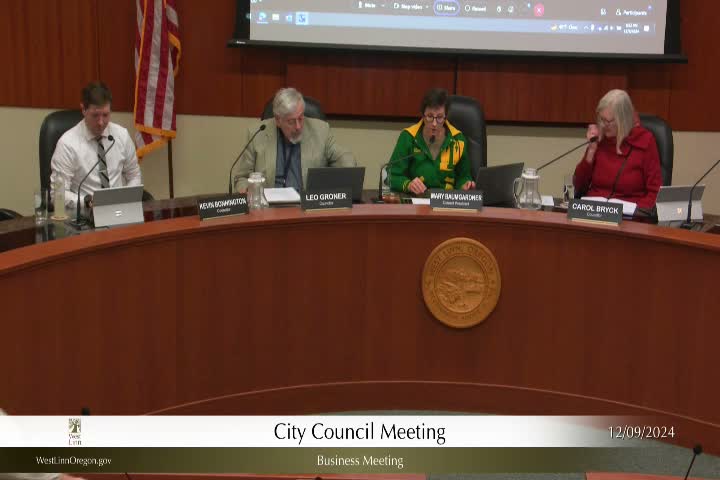
After the public hearing closed with no public testimony on the ordinance, a council member moved to approve the first reading and set a second reading; the council later moved to approve the second reading and adopt the ordinance. The motion carried unanimously by roll call.
The council thanked the planning commission for multiple work sessions and public review that informed the final language. The ordinance will take effect according to the city’s adoption timeline and the city will publish the consolidated code language and any administrative procedures associated with the changes.
What’s next: the city will update public guidance and forms to reflect the new appeal‑application requirements, extension timing and the defined vehicle‑trip limits for home occupations.