Get Full Government Meeting Transcripts, Videos, & Alerts Forever!
Get email alerts on the Wildlife Ordinance topic
No spam. Unsubscribe anytime.
West Linn council weighs new ordinance to curb intentional feeding of wildlife
Summary
At a work session, councilors and staff discussed a proposed ordinance to address extreme, habitual feeding of wildlife after residents raised complaints; staff said the city lacks an enforceable provision and recommended drafting a nuisance‑based code focused on impacts, then circulating it to neighborhood associations for review.
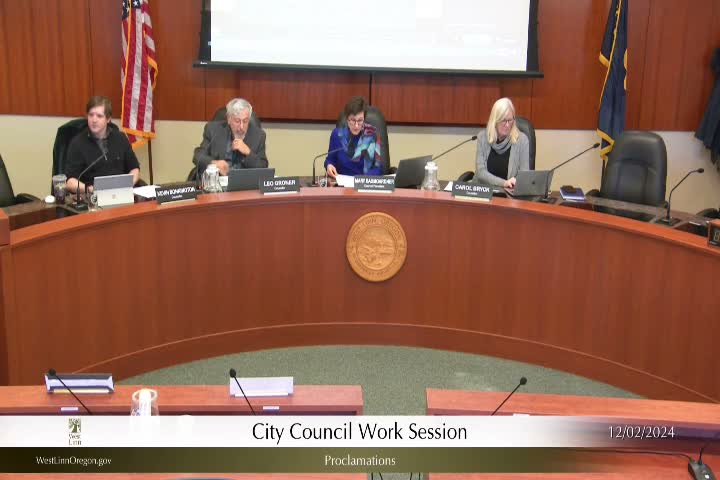
Presiding officials and staff at a West Linn City Council work session discussed a proposed ordinance to prohibit intentional, habitual feeding of wildlife after multiple neighbors complained that feeding had become a public nuisance.
Code Enforcement Officer Nicola Higbee told the council staff could not find an existing, directly enforceable provision in the municipal code to address the most extreme feeding cases. "We pulled provisions from other city ordinances around Oregon to compile the West Linn proposed ordinance," she said, adding that the draft would place a new provision under chapter 5.425 as a public‑nuisance violation aimed at "extreme cases of intentional feeding of wildlife." Higbee said enforcement is complaint‑driven and ordinary backyard bird feeders would not be covered.
The issue arose after neighbors reported concentrated populations of animals — most prominently skunks — that staff said can number 10 to 20 in problem cases. Higbee described the typical enforcement sequence: staff first send a letter asking a resident to discontinue the behavior and refer appropriate parties to dispute‑resolution services; citation is not the first step. She said some repeat violations result in multiple citations because "each day is a separate violation," and that in local practice a Class A municipal violation carries a presumptive fine of about $440, subject to judicial discretion.
City Attorney Klein advised the council that the municipal code already contains many enumerated nuisance types and a catch‑all provision (section 5.495) that permits the council to declare a nuisance, but that relying on a case‑by‑case declaration may not be practical. "We didn't think [the catch‑all] was the most functional way because basically anytime there's this issue it would have to be presented to you," Klein said, recommending staff craft language that targets the impact on neighbors or public health rather than naming specific species.
Several councilors urged a measured approach. Councilor Bryke and others said the goal was not to punish reasonable wildlife interaction such as bird feeding, but to address habitually harmful behavior. Bryke said neighborhood outreach could help determine how widespread the problem is; Higbee estimated a handful of concentrated households per extreme case and said she currently knows of two active extreme situations.
Council members generally supported refining the draft ordinance and sending it to neighborhood associations for feedback. City Manager Williams said staff expected to have a version ready to circulate shortly and suggested the council could take action in January if the code is in a comfortable form and associations have time to review it.
Next steps: staff will refine the draft language to focus on impacts, circulate it to neighborhood associations for feedback, and return to the council with a revised draft for potential action in January.