Get Full Government Meeting Transcripts, Videos, & Alerts Forever!
Get email alerts on the Parking And CFEC topic
No spam. Unsubscribe anytime.
West Linn staff recommend removing parking mandates under state CFEC rules; public hearing set for Nov. 12
Summary
Planning Manager Darren Wise presented a CFEC-aligned code amendment package (Ordinance 1754) proposing elimination of many parking minimums, EV charging conduit requirements, a 40% tree canopy target for large parking lots, and code cleanups; Planning Commission recommended adoption and council set a Nov. 12 public hearing.
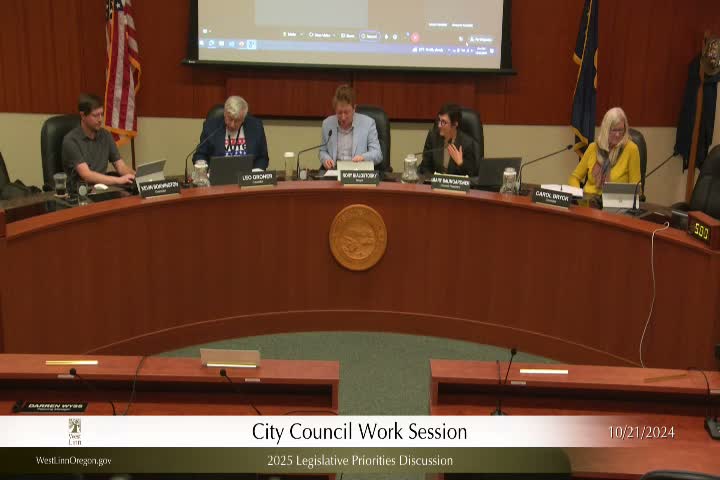
At the Oct. 21 West Linn work session, Planning Manager Darren Wise presented a recommended code amendment package to align the city’s Community Development Code with the state’s Climate Friendly and Equitable Communities (CFEC) administrative rules. The Planning Commission unanimously recommended council adoption and staff said a council public hearing is scheduled for Nov. 12.
Wise summarized the CFEC requirements and the staff recommendation: "It requires the city of West Linn and all other cities and communities to do four things: reform parking mandates and amend parking lot design standards, prepare for the electric vehicle future, plan for future transportation options, and adopt the Metro 2040 town center boundaries." The staff package (referred to in materials as Ordinance 1754) strikes many references to off-street parking minimums across roughly 15 code chapters, adds EV service-capacity definitions and conduit requirements, and adds a required 40% tree canopy coverage for new parking lots of a certain size.
Key elements: • Parking mandates: Staff and the Planning Commission recommended eliminating minimum parking requirements across most of the city, noting that Highway 43 and other corridors already have no-mandate status where transit frequency meets the CFEC threshold. Commercial property owners whom staff consulted told planners they would likely continue to provide parking for market demand and financing needs, but raised spillover parking and enforcement as practical concerns.
• EV readiness: The package requires EV service conduit infrastructure in qualifying parking lots so charging can be deployed later without rework.
• Design and environment: Amendments add submittal requirements for parking-lot design, relax maximum distance rules in some cases, align maximum standards with the Metro regional transportation functional plan, and include a 40% tree canopy target and soil volumes to support tree planting in large parking lots. Staff noted an option to allow solar canopies but chose canopy coverage for ease of implementation.
• DLCD compliance: Staff reported receiving DLCD comments and added clarifying language that local variances cannot conflict with state administrative rules or the Oregon Revised Statutes — for example, the 40% canopy requirement cannot be removed by a local variance.
Councilors asked technical questions about overlaps with public works stormwater standards, where parking shortages exist (historic Main Street and the high school were mentioned), and whether paid on-street parking would be off the table after adoption. Staff replied that a paid-parking district remains an option the council could pursue independently after adoption.
The Planning Commission’s unanimous recommendation, consultant outreach to local commercial property owners, and staff clarifications on DLCD input were presented as the basis for moving the ordinance to a public hearing. The council set that hearing for Nov. 12 and staff will return with the formal hearing materials for consideration at the business meeting.