Get Full Government Meeting Transcripts, Videos, & Alerts Forever!
Get email alerts on the Housing Production Strategy topic
No spam. Unsubscribe anytime.
Consultants outline housing production strategy for West Linn; council asks for more data on SDCs and tax tools
Summary
Consultants presented a draft housing production strategy recommending zoning incentives, SDC adjustments, tax tools (TIF, CET), land acquisition and targeted tax abatements; council and planning commissioners asked for modeling of SDC and CET impacts and public outreach before adoption.
Consultants for West Linn presented a draft Housing Production Strategy (HPS) at the Nov. 18 joint meeting with the Planning Commission, proposing a focused set of implementable strategies to support production of smaller and affordable housing over a six-year period. Matt Hasty, leading the consultant team, said the plan narrows a long list of options to those the city can reasonably implement and highlighted near- and medium-term steps including rezoning parcels for higher density, incentives for smaller-unit development, and zoning bonuses for workforce and affordable housing.
The consultants recommended several financial tools to unlock development capacity: targeted reductions or deferrals of systems development charges (SDCs) for accessory dwelling units (ADUs) and affordable units; exploring tax increment financing (TIF) in the waterfront and Highway 43 corridors; and evaluating a construction excise tax (CET). Hasty noted the CET is limited by state rules and typically capped at about 1% of residential permit value and that jurisdictions vary in experience using CET proceeds to subsidize affordable housing.
Councilors and commissioners pressed for additional analysis before the council commits to revenue tools. Commissioners and staff said West Linn currently has among the highest SDCs in the metro region for single-family permits and that SDCs for ADUs can range approximately $10,000–$20,000 depending on utility connections. Several speakers asked consultants and staff to model how a CET would affect developer interest, project timing, and the city—s revenue picture; staff agreed to prepare more information and refine the SDC comparison tables in the report.
Consultants also proposed non-financial strategies: encouraging smaller-lot single-family development, zoning incentives tied to affordability or accessibility, surplus-land acquisition or land banking, and a Fair Housing education/referral program. Working-group feedback showed broad support for zoning incentives, land partnerships, and Fair Housing education while recommending further public outreach and refinement of details such as eligibility rules and implementation timelines.
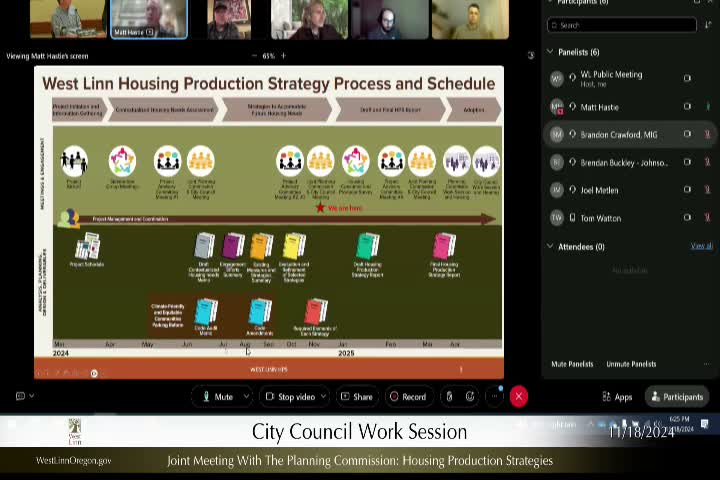
The consultants outlined next steps: draft a preliminary HPS, conduct broader community outreach in early 2025, return to the project working group and the Planning Commission for revisions, and then bring a final draft to the council for adoption in spring. Staff emphasized that DLCD monitors HPS implementation and that strategies need to address housing needs identified in the city—s contextualized housing needs assessment.
The council did not vote on the HPS; members asked staff and the consultant team to provide additional comparative tables, modeling of revenue and development impacts for SDC and CET scenarios, and more public-facing materials before the formal public review and adoption process.