Get Full Government Meeting Transcripts, Videos, & Alerts Forever!
Get email alerts on the Legislative Priorities topic
No spam. Unsubscribe anytime.
West Linn hears Salem lobbyist outline 2025 priorities; Highway 43 funding emerges as local ask
Summary
At its Oct. 21 work session, West Linn council heard contract lobbyist Doug Riggs outline four likely 2025 legislative priorities—transportation, K–12 education, behavioral health and infrastructure—and discussed local advocacy focused on Highway 43, jurisdictional transfer and alternatives to tolling.
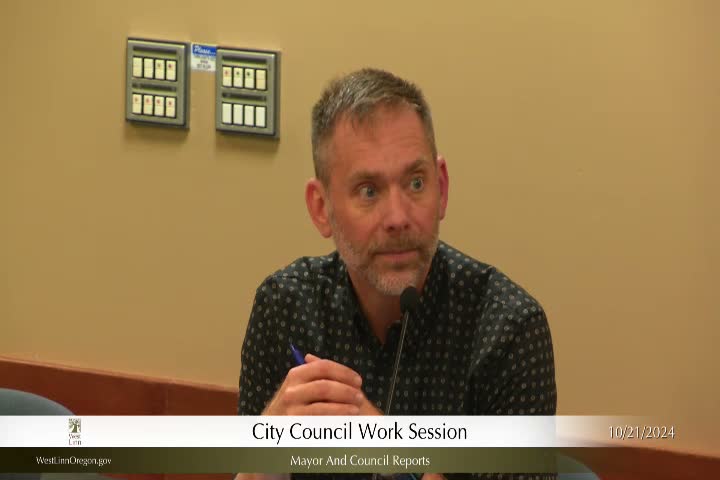
At a West Linn City Council work session on Oct. 21, contract lobbyist Doug Riggs told councilors that the 2025 long legislative session will be dominated by the state budget and four principal issue areas: transportation, K–12 education, behavioral health and infrastructure, including housing.
"It's going to be a session that will be defined by crafting the budget for the '25 through '27 biennium," Riggs said, describing a May revenue forecast that will shape funding available to the legislature. He cited what he described as a large ODOT funding gap, saying, "ODOT, I think, is saying, hey. We have a $1,800,000,000 hole." Riggs urged the council to coordinate advocacy trips to Salem and to work with the city’s legislative delegation.
Why it matters: West Linn’s priority requests must compete statewide for limited state revenue. Councilors focused on Highway 43 as a locally urgent infrastructure need: the mayor urged the city to press for orphan-highway funding and suggested jurisdictional transfer so the city could control reconstruction and longer-term maintenance more efficiently.
Riggs and councilors discussed alternatives to tolling. "The information ... about the incredible inefficiency of tolling as a mechanism for raising money for transportation projects really calls into doubt whether or not that's a very smart way," Riggs said, adding that for some projects—he cited the I-5 Columbia Crossing—tolling may still be used. He warned the council that administrative costs for tolls can be high, noting, "when you spend 70¢ or 65¢ of every dollar collecting the toll ... that leaves precious little for the actual construction."
Councilors asked several policy and technical questions. On housing, Riggs said the legislature has put about $1.4 billion into housing over recent sessions and that programs such as the LIFT fund remain a source of infrastructure dollars cities may use for multifamily and affordable housing projects. Councilor Bridal cautioned against statewide “one-size-fits-all” mandates given West Linn’s limited infill potential and steep topography and urged flexible state options and infrastructure grants to support local solutions.
On Highway 43 specifically, staff and councilors discussed jurisdictional transfer trade-offs: while local control could speed contracting and lower costs, the city would assume long-term maintenance obligations requiring careful financial planning. Riggs recommended coalition-building with neighboring cities and the League of Oregon Cities to increase leverage in Salem.
Next steps: Councilors asked staff to coordinate advocacy discussions with Riggs and to prioritize Highway 43 among the city's legislative asks. Riggs said he would incorporate council priorities into his outreach in Salem and follow up on coordination for legislative visits.