Get Full Government Meeting Transcripts, Videos, & Alerts Forever!
Get email alerts on the Housing Middle Housing topic
No spam. Unsubscribe anytime.
West Linn staff: middle‑housing rules produced 14 projects, 43 new units in two years; council to revisit policy choices
Summary
Planning Manager Darren Wise told the City Council that West Linn approved 14 middle‑housing projects between July 2022 and July 2024, resulting in 47 lots and about 43 new dwelling units (35 detached plexes and 8 townhouses). Councilors flagged concerns about tree loss, larger homes in R10 zones and whether the code is producing affordable housing; staff recommended next steps in the housing production strategy.
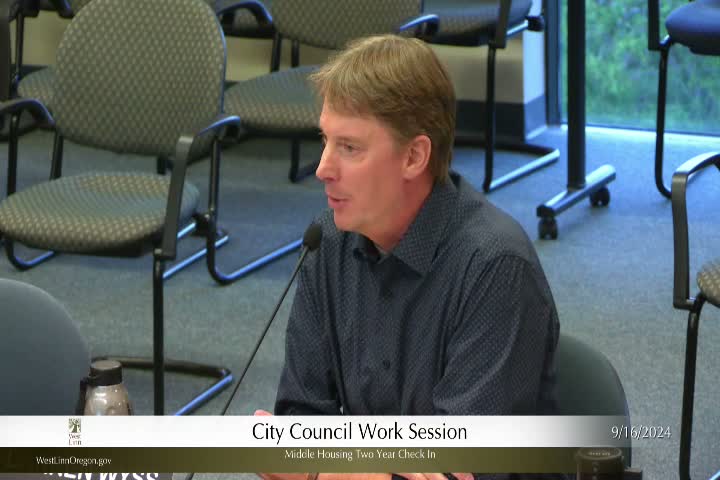
Planning Manager Darren Wise told the West Linn City Council on Sept. 16 that the city has approved 14 middle‑housing projects since the city adopted code amendments to comply with House Bill 2001 in June 2022.
"From July of 2022 to July of 2024 we identified 14 middle‑housing projects," Wise said. "That resulted in 47 lots and about 43 new dwelling units — 35 detached plex units and 8 townhouses." He said all of the projects used the Senate Bill 458 land‑division process so the new units are on individual lots intended for homeownership.
The findings were framed as a two‑year check‑in to help the city evaluate whether the adopted code changes are meeting community goals and to feed the city’s housing production strategy. Wise summarized the implementation as a two‑phase project: a technical Phase 1 to bring code into compliance and a Phase 2 engagement effort that generated 722 survey responses and a working‑group recommendation.
Why it matters: Councilors and staff said the middle‑housing changes did increase the number of buildable lots within the city — in many cases roughly doubling the number of lots that could have been created under the old code — but they raised questions about the kinds of homes that have been built and the outcomes for affordability and tree canopy.
Council members asked whether the decision to increase maximum floor‑area ratio (FAR) in some zones — from 0.45 to 0.60 in R10 and R7 for certain plex types — had produced larger, higher‑priced homes. Wise responded that R10 lot sizes (10,000 square‑foot minimum) and the SB 458 division are primary drivers of observed outcomes: "We're seeing 17,000‑square‑foot lots get three detached plex units, which essentially behave like single‑family homes," he said, adding that projects that retained an existing home tended to produce smaller units and lower price points on the additional lots.
Council concern focused on two recurring themes from public comment and staff reports: loss of tree canopy on redeveloped lots and whether the new supply is reaching low‑ and moderate‑income households. "Middle‑housing wasn't directly intended to create affordable housing," Wise said. "It was anticipated to be an ancillary outcome. That hasn't reliably happened, so the housing production strategy will consider additional tools and incentives."
Next steps: Wise said the consultants working on the housing production strategy (MIG) will present a distilled set of strategies to a working group in October. The goal is to narrow options across four categories — land supply; policy, zoning and code; incentives; and funding programs — and return a short list of strategies for a joint Planning Commission/Council meeting in November before drafting final recommendations.
What council said: Several councilors urged the city to revisit choices about FAR, lot coverage and townhouse allowances, and to address tree‑protection and System Development Charge (SDC) policy as part of the six‑year strategy window. "If we want 1,000 new units in 20 years, we're not on pace yet," one councilor said. Staff agreed to bring refined options to the working group and the November joint meeting.
The city will continue monitoring outcomes and report back through the housing production strategy schedule.